Sent to you by Jack via Google Reader:


Things you can do from here:
- Subscribe to Darryl Sloan using Google Reader
- Get started using Google Reader to easily keep up with all your favorite sites


Hailed as part of a new generation of NY-based gay zines, Pinups is the project of photographer Christopher Schulz, who's cut all the boring bits out of dead-tree publications and created a magazine that's nothing but centerfold. Both subversive and sexy, Pinups is the antithesis of the polished, plucked and bronzed images that dominate traditional gay magazines. Instead, the guys featured are engagingly accessible, while still being sexy and erotic.
It's one of our favorite zines here at Queerty, and on the occasion of the release of the magazine's eighth issue, we talked to Schulz about what it's like to use hot, naked guys to subvert the gay establishment and how to make it as a one-man publisher.
QUEERTY: So, to someone who's never heard of Pinups before, how do you explain it?
Christopher Schulz: It's hard to explain it in a sentence or two. In Printed Matter's announcement of the issue eight launch, they said Pinups is an ongoing artist's publication playing on the historical centerfold practice of nudie magazines by making the centerfold the sole feature. That's probably the most concise explanation that I've seen. More concise than mine!
What's the appeal of making a magazine that's just a centerfold?
I've always been drawn to the process of creating something in the format of a publication, but there are already so many magazines out there and nearly all of them are made up of punny headlines, a review section, interviews, articles, advice columns, ads, and so on. I figured that if I were to bring another magazine into the world it would have to be drastically different. As the creator I have the freedom to define the formula of the magazine, so it's appealing to me, but it's also refreshing for those who look at it—it's an entirely different experience from looking at a conventional magazine. It's more than just a flip-through. The magazine can be taken apart and the pages can be tiled to form a 70" x 32" image. So it involves interaction and can exist in the form of a book or a poster.
Where did you get the idea to do it? How did you first start the magazine?
I was looking at an old issue of After Dark and I noticed an ad for a beach towel that featured a head-to-toe image of a beefy looking guy in a Speedo. I started to think about the formula of porn magazines and how the main feature is the centerfold, and then I thought about enlarging the centerfold and removing all the fluff that many readers disregard.
When I started, I knew nothing about printing or how to lay out the pages. It took me a year to experiment with the format and contact printers before I put out the first issue. Originally I intended on printing it on newsprint and have it come apart much like a newspaper. I got nowhere with printers, and was so frustrated that I hit a point where I realized that if I don't print it the old fashion "'zine" way (Xerox) then it would never happen. The first year I printed the magazines using a Xerox printer. The magazine is now printed on an offset press.
Pinups has been described as part of a thriving gay 'zine scene by New York Magazine. What did you think of the article? It sort of seemed to say that gay 'zines are the future of gay print media.
I would say that gay zines are a taste of what's to come. There's something liberating about a bunch of artists that are taking gay media into their own hands and really challenging the standard. Hopefully these magazines will inspire their mainstream counterparts to be more thought provoking and dimensional.
How do you pick your models?
Most of the models I've featured have been close friends of mine, and many of them live in New York. Some guys I've invited to be in the magazine because I think they'd be a good match, and others ask me if they can be included. I always do test shoots before picking the models because I want to know how comfortable they are in front of the camera. The guys that I have worked with have been amazing. They agree to be in the magazine out of a love for the project and they really trust what I'm doing, so the collaboration between us has been very organic and easy-going. The photo shoots have always been fun and relaxed. I'm always stressed before and after the shoots. The most exciting part of the process is the photo shoot.
Describe the perfect Pinups model.
It's important that the models are comfortable with themselves. I'm not interested in capturing body shame—there are no waxed bodies in Pinups; no painted on muscle tone. I'm not dolling guys up to sell anything. The perfect model is comfortable with his body and isn't afraid to show it. Hopefully that comes across.
Is there any political or social meaning to the magazine?
I want to present an alternative to imagery that perpetuates the ideal body as being overly toned, overly tweezed, and overly Photoshopped. I'm inspired by all the nude photo books and magazines that came out of the 70s. Models were presented in a very neutral, almost documentary style. Some friends of mine showed me a book they had from the 70s that was basically a portfolio of images of all sorts of different people, photographed nude in a photo studio. The only text was the name of the person and their profession. It was genius. That's how I want to present the guys in Pinups—the nudity is natural, not pornographic. Similarly I believe peoples' responses are projected, not provoked. I think it says a lot for a magazine without words.
What do you have planned for the release party?
This time around, Printed Matter is hosting the launch, which is very exciting because there is really no other place quite like Printed Matter and it is the perfect context for Pinups. It's sort of a hybrid of a gallery and bookstore and carries works from zine makers you've never heard of to artists such as Yoko Ono and Barbara Kruger. It's really the most incredible range of works you'll see in one place.
Pinups Issue #8 will have its official launch on Saturday, Jan. 24 at Printed Matter (195 Tenth Avenue, NYC) from 5-7pm with an after party at Nowhere Bar (322 E 14th Street, NYC) at 10pm. Needless to say, come as you are.
The Horrifically Complete Non-Winner Now Available! $13
Here it is, the perfect book for anybody who has ever enjoyed a good journal comic. Well, almost anybody, as I guess if you hated Kelli's work for some reason this wouldn't be for you, but what's not to like here? This is the complete (as that cover may suggest) collection of her Non-Winner strip, done from 2001 through 2005. I'd never seen plenty of these, as she did most of these online, and it's taken me weeks to get through the whole thing, as I've been picking it up and reading bits of it at a time. If you've ever read a journal comic and thought "what the hell were they thinking with this one?" or "this week's strip looks like a complete waste of time", well, Kelli is kind/neurotic enough provide commentary for every single one of these, going into details about her fractured family life and other personal details. At times the quality of the strips aren't the best, as these were taken from her computer and some of these were designed with color or odd little tricks, but it's only noticable on a very few of these. Topics in here include pretty much everything in Kelli's life for those 5 years: family, married life, video games, comic conventions, dealing with publishers, hating (then eventually loving) Joss Whedon, and just about everything else you could think of. As for the commentary, I thought it would get on my nerves, but it ended up being completely fascinating. She adds all sorts of tidbits to everything, taking full responsibility when the strips sucked (mostly the "throwaway" type strips that she had to do while under deadline for something else) and adding relevant information to everything, including the awkward fact that her family did read her strip although she really, really wished they wouldn't. For anybody who has ever wondered exactly what goes into making a journal strip, this is the perfect book for you. Hell, even if you aren't even a little bit curious, you can still just ignore the commentary and enoy the strips. It's a thoroughly enjoyable book, and it's a damned shame that she decided to (temporarily?) give these up. $13
When I Was Brave
This is half of a split book with Robyn Chapman, just so it's clear. It's the story of Kelli from her first year of Junior High School, back when she was 12. It's short, sure, but it's incredibly dense for being such a tiny thing. It's basically all about an old teacher of hers, an elderly (and possibly drunk) old black man who had no control of his class and was walked all over consistently. Kelli decides to tell him the truth when the class has him convinced that a test is supposed to be open book, and the rest of the book is about the consequences of her doing the right thing. I liked it. Liked the blocky art and I liked the dilemna of doing the right thing when nobody wanted her to and it might end up getting her punished. This is tiny, sure, but it's worth checking out. Go to the website or send her an e-mail, I think this was $2. Sorry about the crappy scan…
Tomato Now Available! $1
Well, as you should be able to tell from that scan, this is a dream comic and, as such, might not make much sense in any kind of linear fashion. I think it would have been funnier if she had left out the fact that it's a dream comic and let people try to figure it out for themselves, but I'm sadistic that way. This is about a young girl who goes to join a school for girls. Whether she's a teacher or a student isn't exactly clear, but we do know that she's younger than the other girls. Anyway, she hears some scandalous stuff at lunch, then is mistakenly thought to have made a racist comment, and I'm on the verge of telling you the entire comic here so I'll just stop there. Dream comics are always interesting to me because it's a little peek into the subconscious of the author, however unintentional. It's a shortie, sure, but it's a good little book. Contact info is up there, or you could just buy this in the store, if you were so inclined…
Three Questions About Daddy Now Available! $4
This is one of those times where a comic is a tactile experience, or at least the cover is. I really wish there was some way for you guys to feel and smell this cover. Scientists, get on it! The cover is made out of leather (or fake leather, I'm no expert) and this will remind plenty of people immediately of childhood and the wallet that your Dad always carried around. Kelli made this comic from the responses of 16 people to 3 questions: How would you describe your father, how would you describe your relationship with your father, and what's your most outstanding memory of your father. Responses range from relatively flip to gut-wrenchingly honest, both positive and negative. I'll be the first to admit to being prone to hyperbole with my reviews, but this is a fantastic comic about life, really, that's not to be missed. Unless, of course, you're one of those mythical people who has never had a single problem with your father and have no interest in people who have. This is $4 and is in my online store, or you could just click on the contact info up there and head to her website, where you could check that out and all kinds of other things.
Non-Winner #1 Now Available! $1
Blurb! That's one problem I have with the fact that the online store shows a sentence or two, as now I'm apparently supposed to keep that in mind when I'm rambling and try to sum it all up in a brief soundbite, and I'm completely unable to do that. Sorry. I could just say "I loved this comic!", which I did, by the way, and then go down from there, but that would indicate order of some kind, and I'm completely against that. Anyway, review, oh yeah. This is a dense collection of tales from Kelli's life. The first half is about a summer vacation she took with her husband, then you have facts about her personal art history and going to art school, losing the Xeric Grant, being ugly (her words), and still being ashamed today of somethiing she said more than 12 years ago. Look, all I really want out of a mini that only costs a buck is that is be entertaining, and this has that, plus it takes a while to read (she uses a lot of text), PLUS it has a cover made out of what looks like coffee holder materials. Great stuff all around and cheap too, I only hope that the other issues of this are as good as the first one. Like I said, it's $1, contact info is up there, or you can head on over to the store, where you can also buy it. You do get that I'd be saying all these nice things even if it wasn't in the store, right? OK, good…
Non-Winner #2 Now Available! $1
Has everybody out there read Happy #2 by Josh Simmons? If not, you may be a bit lost on this one. In it, Josh has an extended rant about the state of autobiographical comics, from the quality of the art to the depth of the stories, to everything about them, really. I'd say check it out for yourself, even if you don't agree with it there's still the rest of an issue by Josh Simmons to enjoy. Anyway, this is mostly Kelli's response to that rant, with all of her insecurities and fears about her own self-worth taking over. After that is a short story about the best response that I've ever heard to those annoying singing wall fish that were so popular a few years back. Great stuff again, although a much quicker read than the last one, not like that's a big deal in any way. Contact info is up there, it's $1, you can also find this in my online store…
Non-Winner #3 Now Available! $1
What do you like better out of a mini, one big story or a bunch of tiny, relatively random ones? Well, if it's the latter, you're in luck! And if it's the former, well, expand your horizons a bit! This one is all over the place, and there are no handy little titles to let you know when the story is changing, so pay attention! In here she talks about her main memory of a dead Uncle, getting laid at least in part because of a dream involving Dragonball Z, her immediate reaction to the divorce of her parents, supporting the troops at Lowe's, and still having regrets for tattling in the sixth grade. Oh, and more insecurity about having all of her good stories come from when she was in grade school and how her best years are behind her. I liked this one too, although probably not as much as the other two, if that means anything to you. Still very much worth a look, contact info is up there, this is $1 and it's also available in the online store…
Invisible Momma Now Available! $1
Not sure how this one slipped through the cracks, as it was in the box of comics that Kelli sent me for the store months ago. it was kind of buried, I guess, but I think it means I'm just stupid for not seeing it. Oh well, now that I have seen it, how is it? Shockingly, as I seem to like most of her work, I like this one a whole lot too. This is the short story of the life of her mother, a life that Kelli hadn't thought all that much about until she was out of college. This is set up like the sample, a panel per page with one drawing above it. If she hasn't yet she should write some stories; she has a real gift for prose. This one is mostly a tale of regret about not getting to know her mother and confusion as to how to tell her about it, and at least a little bit of a sense of loss on what her mother had to give up to raise a family. Great stuff, probably her most powerful book outside of Three Questions For Daddy, and that's other people giving quotes. $1
The Dream Project Now Available! $2.95
And here I was thinking that my trolling the store to find comics that were never reviewed might have been a waste of time. If I hadn't, when would I have ever finally read some of these comics that slipped through the cracks? The last of Kelli's book I had to review (the phenomenal Horrifically Complete Non-Winner) was done over a year ago, and here this one sat. This is, as you might have been able to tell from the title, a dream comic, with brief bits at the end about the nature of dreams and a bit at the end about the best way to lower dream recall, which is an interesting change from people who want to remember absolutely everything about their dreams. This is damned near a pitch perfect representation of a dream. Kelli's focus will shift to a light, which leads seamlessly to her staring at a clock. Figures will remain throughout the dream (but they'll age several years through the course of the dream), Kelli knows instinctively who is evil and who she likes, regular events of the time will get thrown in along with absurdities that seem perfectly normal, like Kelli asking for the rest of the water from the pool of the INXS singer who killed himself. It's silly to summarize the story, as it's a dream comic, but this does manage to maintain the bizarre consistency of a dream, the sense that everything comes together at the end even though there's no logical reason for it to do so. For those of you who may have forgotten about Kelli on this page, or for you new folks who have never seen her stuff, take a closer look. At this issue, sure, but there's a whole pile of goodness on this page. $2.95


He started with Threat! for Fantagraphics and Superswine comics for Kaptain Keen & Kompany. He also spent 15 years at CRACKED Magazine, and made Nickelodeon comics for Marvel, and H-B and Cartoon Network comics for DC. Basically, Fields is a pro.
Currently he works full-time for The Children's Place, creating cool graphics for T-shirts and toys, but he still draws gag cartoons for Nickelodeon Magazine and National Geographic Kids and comics for Image Comics' PopGun volumes. In his spare time he works on personal projects, such as this strip inspired by a cat-loving friend of his. Enjoy!
- Sarah Morean


Genre: Sci-fi
Age Rating: Older Teen (16+)
Price: $10.99
I had some pretty high hopes for 07-Ghost going into this review. I had read the preview of the first volume on Go!Comi's website, and I was ready to get into the fantasy of the whole series. Now, I knew before getting into the series that there would be fan-girl pandering, some "manservice" if you will, but I was willing to give the series a shot because of what seemed like an interesting premise.
Nevermind all that. If you like the front cover, if you think its cute or hot or sexy, or whatever you might think, go for this book. It's worth your time. But if you are looking for a bit of a plot, or character development, or even a story setting that made some fricking sense, this is not your cup of tea.
07-Ghost is a sort of cliched European fantasy-techno adventure where the main character is named Teito, and he's a sort of emo-magic-soldier boy. He runs away when the country he's a soldier for begins to attack him, and he finds out that instead of being a slave, he's actually a prince of a kingdom that was conquered, and holds some powerful secret that the other side (the side he used to be a soldier for) wants to get, at any cost. That's pretty much all I got out of it, because most of the book is consumed with super-sexualized monks, poses not unlike the cover of the book, and other shinanegans.
Oh, and that whole "having a best friend who has half of his soul stolen, and says, "I love you." right before he tries to kill the main character" thing is kind of awkward.
Along the way, we get some pretty fricking confusing action scenes, there's a mermaid, and talk about a god that looks somewhat like a Grim Reaper figure with wings made of bone.
If the story isn't necessarily what you're looking for, there are plenty of amazingly drawn... manservice panels, and most of the book is actually well visualized. It's pretty, and Go!Comi did a good job with the production of the book. However, I think it's fairly safe to say that this book was not published for guys like me.
Dirty Beast #1
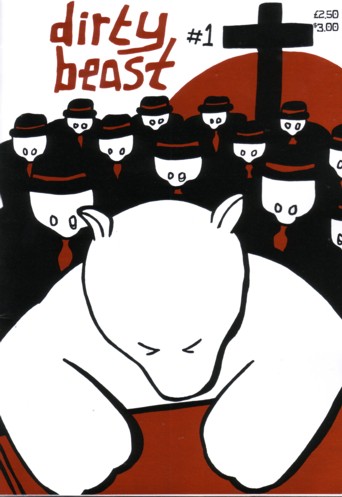
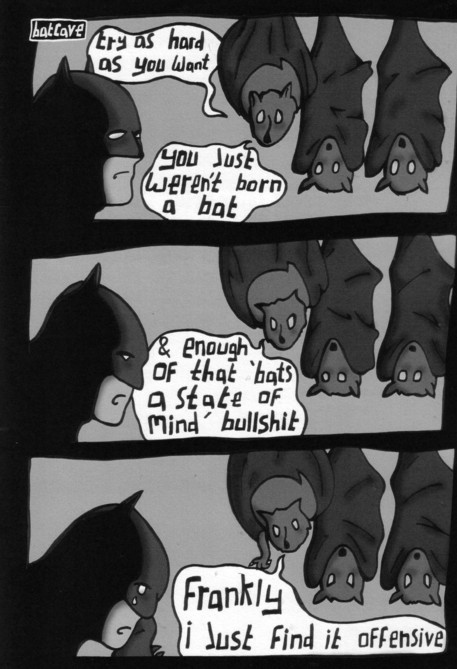
Just so I can get it out of the way in the first sentence for people who like easy comparisons: this comic reminded me more than a little bit of Arsenic Lullaby by Doug Paszkiewicz, except funnier. This mini is a barrage of short pieces with no story titles or anything to indicate any changeover in the story, except of course for the fact that the story changes. It got me wishing for another page or so more than once, so I think that means Chris was doing his job as an artist. Or he was failing miserably in not satisfying me with however many pages he already had planned out for each individual story, depending on your level of pessimism. As it's pointless to review humor bit by bit, I'll just give you some of the general themes (along with the early comparison to Arsenic Lullaby for reference) and you can decide if this fits your humor level or not, OK? There's awkward touching, an adaptive prostitute, wanton destruction, finding humor in a stroke, sex follies, getting the pictures of strangers developed, swimming with sharks, and kidnapping. That's probably vague enough to not give anything big away, don't you think? I chuckled out loud a few times while reading this, and those empty white eyeballs in his art had me damned near hypnotized after awhile. Definitely worth a look to see where Chris goes from here, as more genuinely funny comics (sad that they're as rare as they are) are always a good thing. $3


I'm Not From Here
by Kenn Minter
Near Mint Press

Let the demure write fiction, and sew their own experience into a quilt of monikers and fantasy and fraudulence. Fiction's not real, but it's readable and tasteful to some. Still, I like the grotesque honesty of autobiography, and I want to see it at its best, which is why today I'll pick a little on Kenn Minter's book I'm Not From Here.
An autobiographer is a special animal, my favorite beast. He needs to lay all his fleshy terribleness on the page without excuses, and if he can't, he should go back to storytelling.
I'm Not From Here clearly promises "slightly embellished autobiographical comic strips," but it falls flat as just another weak foray into the genre.
The backbone of autobiography is made up of honesty and openness. When the autobiographical cartoonist gets too protective of himself or the people in his life, it's a disservice to the story and the reader. So while there's much to enjoy about Kenn Minter's book, it could also be seen as an example of what not to do in autobio cartooning.
Today's autobiographical cartoonist reaps the benefit of living in a post-American Elf world. They should realize it and be thankful! But instead, some make apologies and constantly cover up truths. The subtitle of Minter's book says it, the publishing information re-hashes it (The stories, characters and incidents mentioned in this book are embellished or entirely fictional), and even the title implies dissociation from the events inside. It's understood that we shouldn't take Minter's book at face value, so the repetitive reminders are overkill and even insulting to a sophisticated audience familiar with the framework of autobio.
Here is a summary list of autobio's basic tenets: characters have fake names so the real people don't sue, time is not fluid or real-time, imagination will be anthropomorphic, one's physicality is not a perfect copy of reality. So, when Minter says his autobio comics are "slightly embellished" that statement is already redundant and it definitely doesn't excuse the more obscure stories.
For instance, there's a one-page story about "Big Eyes," a girl he's seeing who returns from a trip only to leave him again. The comic is a brief three-panels, and in it just one thing is established. A girl leaves, maybe because she was gay or maybe because she met someone else, but he doesn't say why. It's a total throw-away story for the book that never gets mentioned again, but it probably means everything to Minter, which is why he kept so much of it to himself. But that's what bad autobio is! Because autobio is all about letting people in, secrecy is against the nature of the genre. In the "'Big Eyes' returns" story, he intentionally left the audience out - an autobio no-no.
I've given this a lot of thought, discussed the matter with experts in the field, and come to the conclusion that autobiographical comics are like your first girlfriend. She doesn't need to be pretty, she just needs to put out.
It's the reason why Jeffrey Brown's comics are a mainstay of the genre. The frail, child-like drawings weren't so tough to look at when the promise at the end of the page was a guy's heart ripped biannually from him by some girl who was supposed to make it alright. What's remarkable about books like the girlfriend trilgoy, is that they let readers into the author's private circle. Brown does this by including details that aren't flattering to his ego and even make him look like a pathetic jerk sometimes. It's brave and it's pleading to be understood, but it's only these things because the author didn't play carrot and stick games, which is the bane of most autobio flops.
Joe Matt tells us every despicable thing about himself, and even though we won't shake his hand for the memory of where it's been, we love him for it. The ultimate truth is that to write a good autobiographical comic book, you've got to be honest and a little self-destructive, and Minter didn't prove in this book that he has the chops.
Autobio isn't for everyone. That's the conclusion.
Luckily, Minter is a fabulous artist and has work available in other genres. In I'm Not From Here, the black lines and gray fills move nicely on the page. He has an eye for framing things and picking the right angles - he just won't tell you his girlfriend's name. You can even give I'm Not From Here a whirl and decide for yourself if it plucks your sympathetic, voyeuristic heart strings.
- Sarah Morean


D-Doctor? Are you...God?
Heh Heh. Never had dealings with him.
I was a little saddened to hear Vertical Inc. was not announcing any new manga releases for 2009. Over the past few years Vertical has really raised the bar for quality choices, presentation and translation. The majority of their manga releases are by the godfather of manga, Osamu Tezuka (Ode to Kirihito, Dororo), and while many of the recent releases may not have been so well known in the West until their English releases, the Vertical treatment of Black Jack, now Vertical's only manga series, was highly anticipated. However, this release is not the first time Black Jack has made its way to this side of the Pacific. A decade ago Viz released a few volumes of Black Jack. These were selected stories, not in the order as Tezuka originally intended. New Black Jack translator Camellia Nieh recently talked about the pressures of translating a previously translated work, especially one that was expertly done. In the interview ( http://anime.advancedmn.com/article.php?artid=5348 ) Nieh describes how the goals of this translation were a little different than they probably were in the late 90s. To be sure, manga readers of that generation were looking for readability and highly localized text, where readers today are looking for more authenticity, keeping as close to the original Japanese as possible. Doing this without being distracting is Nieh's forte, and without having read the original Japanese, I can attest she has maintained a very easy to read medical and moral manga drama. (There are sparringly few footnotes included.)
Announcing a 17-volume high-end manga series is an ambitious endeavor, especially in this economy, but after reading just a couple of episodes you will see why this commitment is a solid investment, and why Black Jack is one of Tezuka's most popular characters ever.
The title character is a rogue Japanese doctor. I like stories that start with some mystery rather than a lot of explanations, and Black Jack is the epitome of this style. Dr. Black Jack has no license, he has severe scars across his face which are half covered by his mop of two-toned hair. On top of that he is the most skilled surgeon on the planet. Maybe that is why he has the audacity to charge outrageous prices for his services... only that those prices seem less outrageous when he reminds his desperate patients their other option.
To leave it at that over-simplifies the appeal of Black Jack because despite the originality of each medical episode, the real pull is the ethical struggles of our morally-ambiguous (?) hero (?) and how he applies them to his subjects. From the first chapter of the first volume we are thrust into the fascinating life of the forest cabin-dwelling and globe-trotting doctor. (Dr. Black Jack is as full of more walking contradictions than any manga character I have seen...but even as his mystery unfolds, they hold together.) Over the course of each volume (12+ chapters) we are given hints to the background of our maverick physician. These are doled out carefully and thoughtfully, making each morsel that much more satisfying.
Before going into Volume 3 a little more, I will say what I like about Black Jack is that each story is completely different from the story that preceded it. These are all stories of a medical miracle-worker, but elements come in from out of left field quite often, keeping the reader on his toes, even if Dr. Black Jack is prepared for anything. He globe-trots from major metros to deserted islands. He treats famous kings and sea-life. An episode might cover a few days or several years. The chapter titles are only the slightest hint as to the tale that is to come.
Like Volume 2, I felt that Volume 3 started off a little weak, but boy, did it pick up steam soon after. One thing I liked so much about the first two volumes were the select stories giving us insight into Dr. Black Jack's background and motivation. I was a little disappointed there wasn't a story in this vein here, but what made up for it was Black Jack's more open struggle with the morality of his livelihood. We have seen him charge enormous prices to "evil" people, and the same prices to "non-evil" regular folks. That makes him a hard-to-love hero (apparently on purpose) but in this volume he struggles with that stance more than we have seen in the past.
One of the most interesting (and ultimately frustrating) tales is how Black Jack enacts "revenge" on a distracted doctor who blames his nurse for a fatal mistake. (Another frustrating thing was the amount of "people run over by trucks" in this volume. It happened at least three times, each for a different effect, but if the stories are read in a row it felt a bit contrived.) Another moving tale is of how he "encourages" brazen medical students fed up with their attending surgeon. One of the most touching stories involved a benefactor of the fine-feathered kind.
Over the course of these tales we begin to see more sides of Dr. Black Jack than even the flashback episodes reveal, and we are left with a dark hero seemingly in a state of flux by the end. Black Jack is an episodic, not formulaic tale, so how each episode relates to each other (if they do at all) isn't always crystal clear. What we do know is that Osamu Tezuka has seemingly no limit in his arsenal of approaches with Black Jack, and as each volume ends it becomes easier to see how this formal medical student turned manga writer must have enjoyed giving this character the life Dr. Black Jack himself relishes in giving back to his patients.