Having a disability and surviving on a disability support pension isn’t something to be envious of. If disabled people could trade their money to have your health, they would probably do it, writes Ciara Xyerra.
13 December 2010
I had a pretty difficult conversation recently in which a good friend told me that she is jealous of the security my disability money provides.
I have been on disability since early 2003. I’m one of those lucky folks who was approved the first time I applied. I get it for both physical disabilities and mental health issues.
My mental health issues are mainly anxiety and depression, both of which I have learned to manage pretty well (especially the depression), but which still affect my life in various ways pretty much every day. I have a much more difficult time managing my physical disabilities.
I have some weird birth defect wherein I was born with an incomplete spine. I am missing a few vertebrae in my lower back. I also have fairly severe scoliosis. This may be related to the missing vertebrae. My spine may have learned how to curve over time in order to support the uneven distribution on weight along my back due to the missing vertebrae.
On top of this, I injured my back really seriously when I was 18, in a workplace mishap. I damaged a lot of nerves in my spine and have some fairly minor (comparatively) partial paralysis in the right side of my body. It mostly affects my right arm and my neck.
I went to physical therapy to recover motion and passably normal function in my leg. I was in physical therapy for months, but 13 years later, I can walk pretty normally.
But on top of all of this, I developed arthritis, which has spread all over my body. Ten years ago, it was pretty centralized in my back, hips and knees, but now it’s in my feet, hands, arms, neck and has recently spread to my shoulders.
The arthritis means I live with major amounts of chronic pain every single day. Some days are worse than others. I’ve had days when I couldn’t walk, move my neck, or lift my arms. Those days are fairly infrequent.
My daily battles involve things that other people don’t think twice about. It’s difficult for me to hold and use utensils, button a jacket, and write things by hand. It’s very painful for me to sweep a floor.
Often, when I wash dishes, my hands sometimes lock into claws and I can’t move them. If I’m sitting on the couch reading a book, it’s difficult for me to hold the book open.
Little things like this cause me significant amounts of pain, which is only becoming more severe and widespread as time goes on.
I’m only 31. There’s no cure for arthritis, so I have to make my peace with the fact that these problems aren’t going away and will in fact only get worse.
When I was initially diagnosed, my orthopaedic specialist said I would probably be in a wheelchair by the time I’m 30. Clearly, he was wrong about that. But we’ll see what the future holds.
I also have to deal with the fact that my arthritic joints are more prone to injury and take longer to heal if they are injured. Seven years ago, I sprained my ankle tripping on a rock in my backyard. I had to wear an ankle brace and walk with a cane for six months. I was only 24 years old! It was no fun to roll into a zine fest leaning on a cane.
Chronic pain is pretty much impossible to describe to someone that has never experienced it. I have had some kind of chronic pain somewhere in my body every single day for the last 13 years.
Sometimes, it’s so bad I cry. There have even been times that I have thought about killing myself just to make it go away. (This was especially a big problem right after I hurt my back, when I couldn’t move my right leg at all and couldn’t get out of bed for months on end.)
I’m a lot more okay with it now, just because I’m used to it and have developed some skills for working around it, but it definitely sucks.
Being on disability has literally saved my life. I can’t imagine what job I would actually be able to hold down when my physical limitations are combined with my mental health issues.
I was approved for disability when I was 22, and the government determined from my application that I became chronically and permanently disabled at age 18. Therefore, when my dad died right after I turned 23 and I got divorced a year later, I became eligible for the disabled adult children of deceased parent benefit program.
This enables me to collect disability insurance as well as my dad’s social security guarantee. The thinking is that a parent would financially support his/her disabled adult child if s/he were alive to do so. In his absence, the government gives the disabled adult child the social security benefits the parent would have collected upon retiring.
Disability insurance alone is a very meagre income. It would be a huge challenge to live independently on it. I did it for six months while I was waiting for my divorce to be finalized: $525 a month, and my rent alone was $400. You do the math.
Adding my dad’s benefits to the mix means I am able to support myself independently – although I have to live a fairly frugal lifestyle. Which I’m okay with, because I am/was (?) a punk and that’s how punks roll.
Of course, this is a fixed income. If I find one day that it’s not enough money to get by, I don’t have any options. I can’t apply for a better-paying job. I can’t further my education in hopes of a professional career and the attendant boost in income. This is it.
There are other caveats as well: if I ever decide to live outside the United States, I lose my disability money altogether. If I ever get legally married, the government will pull the extra money I get from the disabled adult child program and I’m back to just my $525 or so in disability money. I would have to rely on my partner to support me financially, which is a lot to ask of someone, and which is something that makes me very uncomfortable.
I’m not sure what the rules are around having assets (i.e., if I were to sign a mortgage, even if I wasn’t the sole person responsible for paying down the mortgage). I’m not sure how social service programs I may be eligible for if I were to have a child (i.e., WIC) would impact my social security income.
So, you know, it’s not a perfect system. But it works for me for now. Not having to sweat the bills and look for a job definitely goes a long way toward helping me keep my depression and anxiety in check, and being able to be a homebody definitely enables me to take the time and space I need to deal with my chronic pain issues.
For example, I can chill out at home and sleep or take a bath if the pain is really intense, rather than forcing myself out to my job. Toward the end of my life as an employee, I was taking a lot of “sick days” that were really “too much pain to get out of bed” days.
I don’t have to worry about that stuff anymore. My schedule is now flexible enough to do self-care things like water aerobics classes, outpatient surgery to cauterize pain-transmitting spinal nerves, etc, without having to take time off.
Okay, back to the situation with my friend. I see very little in my situation to inspire jealousy.
Her main point, repeated over and over, is that it’s a privilege for me to be able to make ends meet without sweating my next pay check (though I’m always cognizant of the fact that the government could pull my benefits any time they want, and I am subject to regular, extremely arduous, review processes).
Is it a privilege for the government to provide a basic income to people who cannot provide an income for themselves? I honestly wouldn’t call that a privilege. I think it’s pretty much the least they could do.
I’m not one of those people who thinks “privilege” is a dirty word and freaks out if someone says I have it in some way…but considering that I get this money because I am disabled, and my disability is a pretty huge detriment to my life, for which I have faced some very clear-cut examples of prejudice and oppression…I definitely think “privilege” is the wrong word to use.
In my years of experience being on disability, I have had several people in my life that seemed jealous or resentful of my guaranteed monthly income. A few people voiced their opinion that I am squandering my money if I buy myself a treat with it (i.e., cute shoes, a decent computer).
I see this as paternalistic nannying bullshit. What, a person can buy whatever the fuck useless or frivolous doodads they want if they go out and earn their money every day at a job, but someone like me should grovel and be grateful for whatever dregs they can get?
These are usually people with a fair chunk of money and financial security, and some unchecked ideas about what poor people deserve. Key word: deserve. These people tend to be very hung up on who deserves what.
The other kind of person in my life has been the person that is struggling to make ends meet themselves, maybe by hustling away at some self-employment, or at a low-paying retail or food service job.
These people are jealous that I make just as much money as them (i.e., not much) without having to leave the house. They seem to think I have a pretty sweet gig going, and sometimes they passive-aggressively congratulate me on “snowing” the government into giving me money.
Believe me when I say I am not snowing anyone. Live a week with the pain I live with every day and see if you think I fooled anyone into declaring me disabled. These people tend to have more jealousy and resentment around my income and financial situation.
They may say something like, “Going to work makes me really anxious, but you don’t see me looking for a hand-out.” and I say, “Why the hell not? If you really think your anxiety constitutes a serious disability that negatively impacts your life on an ongoing basis, apply and see what happens.”
The bottom line is that once these opinions bubble to the surface, the friendship usually doesn’t last too long. I have had really, really bad experiences around this issue, and I think the bottom line is that someone who is jealous of my perceived financial stability due to my disability income is a person who does not take my disability seriously.
It is nothing to be jealous over. If I could wake up every day feeling totally healthy and pain-free and have my dad be alive again, I would gladly work 40 hours a week, even if it were at chipotle or something. But it’s just not an option.
At this point in my life, my pain and my physical limitations are serious enough that I need my friends to take my disability status seriously. It’s a huge part of who I am as a person, and making jokes about it or being jealous basically amount to minimizing a hugely significant and difficult aspect of my existence.
So now I’m dealing with it again and I’m pretty upset. I really thought I’d gotten to the point where I was making good choices about my friends and was only sharing my disability status with people who could be trusted to fully respect that.
I like to think of myself as a good judge of character, but… this happened. I have never ditched a friend solely because they made some fucked-up remark about my disability… but usually the fucked-up remark has been the first indication I’ve had of a toxic stream slowly killing off the friendship.
I am really bummed to think that something like that could be happening again, and I am trying every way I can to try to understand this person’s perspective and give them the benefit of the doubt.
But personal experience has shown me that not taking this remark seriously as a potential cancer in the friendship will only lead to more heartache down the road.
I guess I am writing this for anyone who may be reading who has a friend struggling with a mental or physical disability. I am saying: take that shit seriously. It’s not a fucking joke and it’s nothing to be jealous of.
If your friend’s condition is serious enough that the government has recognized it and is providing for their basic survival, that is a big fucking deal for your friend. They probably have days where they feel unbelievably shitty about the fact that they can’t provide for themselves–even just by washing dishes at noodle and co. plus, they’re dealing with all the restrictions the government places upon them in exchange for their survival money.
There’s a decent chance that that money is the only reason your friend is still alive. Don’t resent them for it; don’t waste your time being jealous of them. Trust me: there’s nothing going on with them that you want for yourself.
If they could trade their money to have your health, they would probably do it. Even if your friend doesn’t often talk about their disability or make their disability-related limitations obvious to you, they still deserve respect as a whole person, and their disability is part of their wholeness. Be cool.
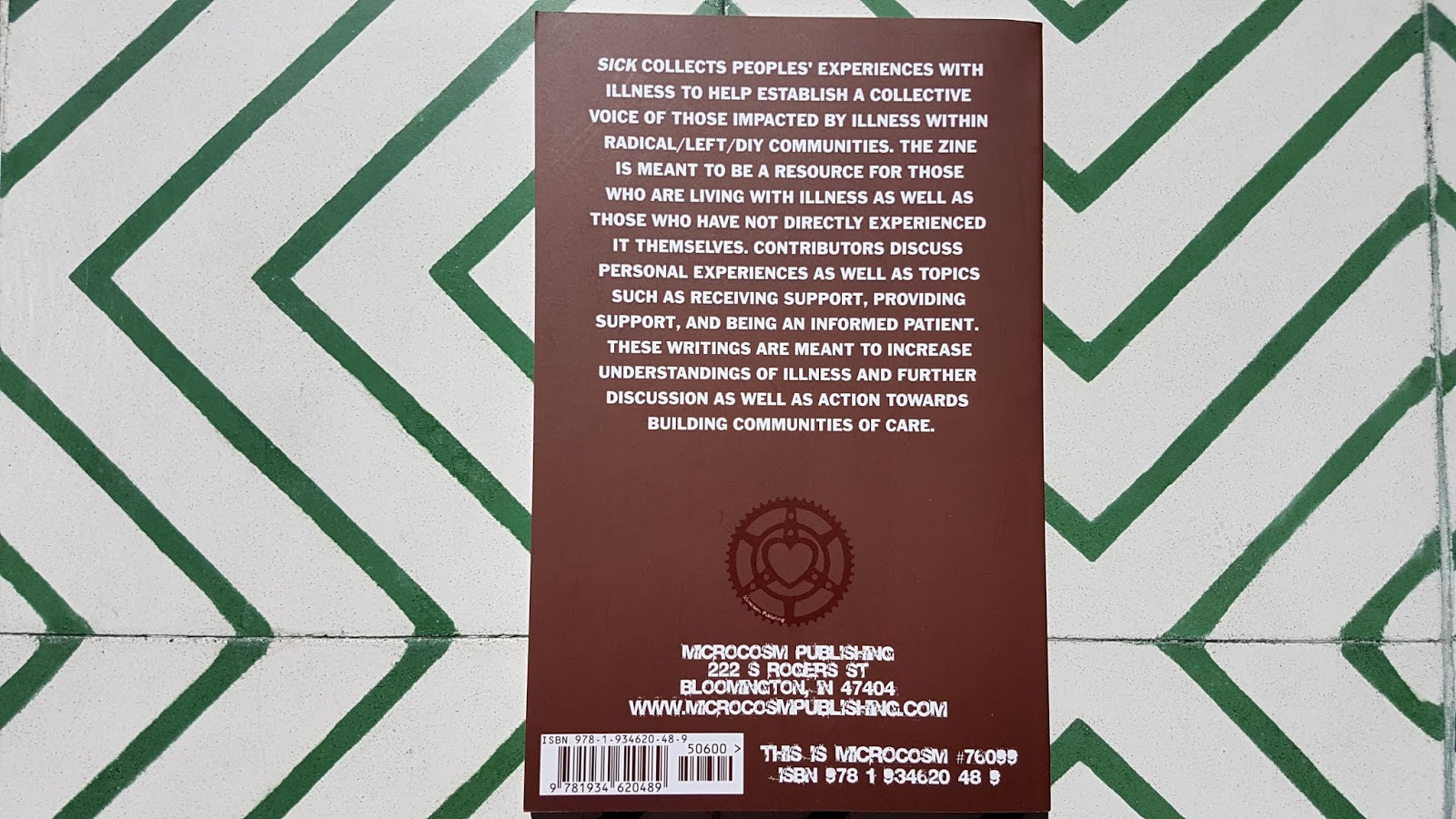
Clara Xyerra has been writing zines for the better part of two decades and ran the - now closed - zine distro ‘learning to leave a paper trail’. Best known for her zines a renegade’s handbook to love and sabotage, up the logic punks! and love letters to monsters she currently blogs at crabigail adams.