zine, [zeen] noun. 1. abbr. of fanzine; 2. any amateurly-published periodical. Oxford Reference

..

Showing posts sorted by relevance for query microcosm. Sort by date Show all posts

Friday, March 5, 2010

Print's Not Dead! Microcosm Zine Store Expands Twice in Six Months!

PRINT'S NOT DEAD! MICROCOSM ZINE STORE EXPANDS TWICE IN SIX MONTHS! Plus, Introducing the ZINE TRIKE!

For Immediate Release


Microcom Publishing Announces Further Expansion
With everyone and their grandpa declaring print media dead, Microcosm Publishing is saying "not so fast, dudes!" For the second time in six months the Microcosm zine store in SE Portland has expanded, moving first from a 9x15' room this July to a 13x15' space, and now upscaling to 22x15' of radical publishing goodness!    The store has all the zines and books Microcosm publishes, such as the DIY guides and Powells bestsellers Make Your Place and the Zinester's Guide to Portland, but it also carries thousands of self-published zines and small press titles. After more than a dozen years in the business, Microcosm set up the storefront 18 months ago--just in time for the recession!   Says Microcosm founder Joe Biel, "In the age of internet bookselling, and when even big box bookstores are on the brink of bankruptcy, you gotta get crafty: The tiniest brick and mortar store and an even smaller zine tricycle seems to be just the ticket to re-establishing reading!"

  A zine tricycle!? Yep, Biel has built a mobile zine trike, a tricycle zine display cart that will take zine culture out onto the streets of Portland! On rainy days the trike is based out of the store, where it functions as display space, but as soon as the sun comes out, the trike goes mobile. "People forget that even shopping is a form of socializing and if we push all commerce onto the internet, we'll be leading some pretty isolated lives," says Biel. "I hope the zine trike will fight that and add a little old-worldly situationism into the mix at the same time."   As the economic downturns continues to put a cramp on US spending, Biel says keeping print alive comes down to one fundamental task: "We don't have investors or loans or outside shareholders. All of our fundraising comes from the most old-fashioned method: selling zines and books."   Located in the ActivSpace Building at 833 SE Main, #108, the Microcosm Publishing zine store is open from noon to 7am every day. Check with twitter.com/microcosmmm for updates on the zine trike! Or visit us online at http://microcosmpublishing.com/   For more info or to arrange an interview with Joe Biel about the Microcosm zine store, the zine trike, or the death of print. 
--
Jessie Duke
Microcosm Publishing
::::::::::::::::::::::::::::::::
Press Department
http://microcosmpublishing.com/press/
609 Rock Creek Dr.
Lansing, KS 66043
::::::::::::::::::::::::::::::::
Check out our new releases! http://microcosmpublishing.com/catalog/our_published_titles
::::::::::::::::::::::::::::::::
Facebook :: facebook.com/microcosmpublishing
Twitter :: twitter.com/microcosmmm
Myspace :: myspace.com/microcosmpublishing

Tuesday, November 9, 2010

I Lost My Sense Of Irony In Brisbane


[16 pages, half digest, $? from Elle, GPO Box 4201, Melbourne VIC 3001, AUSTRALIA]
First of all, I wanna say that after reading Elle's zine, I can reveal that she's got enough attitude and spunk more than equal to an army of ziners. Holy shit, this one gets into it and then some. First of all, she writes about her trip to Brisbane, and her observations are savage. Example: "An entire city's restaurant culture permanently set to "Pancake Parlour" where drinks are proudly served in sundae glasses, and every menu boasts large, heavy bogan Anglo hot winter meals in a city who's winter is still summer." Or how about this one: "Girls, walking around with this season's winter fashion - winter boots and mini skirts. White trash." (That term bugs me though since reading Jim Goad's excellent 'Redneck Manifesto'. See, it's OK for well-off, educated whites to get upset when people call other ethnic groups niggers, beaners, gooks, kikes, ragheads, etc, or call gays faggots, sausage jockeys, clam slammers, etc. but on the other hand it's open season on 'white trash' - poor, uneducated whites who, uh, don't know how to dress in hipster clothes, or whatever.)
OK, moving right along. Elle attends a Brisbane zine fair and this is where things get real interesting and controversial. Elle visits Elouise at her Smells Like Zines distro and finds out that Elouise is selling duplicate copies of one of Elle's old zines, and Elle knew nothing about this. In the zine world, this kind of thing is uncool. Then Elouise reveals that some dude called Luke Bartolo had sent them to Elouise (I don't know who this guy is, but Elle does.) So Elle's put Luke's head on the chopping block too, but she isn't finished. The next section is about Microcosm, the US zine distro. "You cannot NOT acknowledge the political clusterfuck that Microcosm has become", writes Elle, and continues, "... the most objectionable thing aside all the personal stuff is that Microcosm were making duplicates of their zines in stock to sell on and obviously profit from." This is heavy shit, man. Is it true? Let's have some evidence, some corroboration please. I've ordered zines from Microcosm and got some of their catalogues, so my interest level in this is peaking. And what's the deal with Joe Biel? ("It surprised me that Jeremy was unreserved about connecting himself to Joe Biel," - Elle.) What has Joe Biel done? I wanna know. I want to hear from the defense as well as the prosecution. The whole zine ethos is, from what I've understood, we don't fuck each other, and we don't do it for the money. In fact, from my experience, we lose money, but we love it and the connections we make are far more important.
Elle's zine here really started sparks zapping in my brain, asking questions, really got me involved. You can't ask much more from a zine. But there's more to this and I wanna go deeper, get the story from all sides.
[Full disclosure: Elle works (volunteers?) at Sticky. She sends me packets of zines each month to review for the monthly e-newsletter. She's a pleasure to deal with, I love her attitude and passion, so reviewing this zine I've tried to distance myself as though it was from somebody I didn't know.]

Ed Note: more on this @ http://blackguard23.livejournal.com/53141.html

Tuesday, July 31, 2018

The CIA makes Science Fiction Unexciting

The CIA makes Science Fiction Unexciting
Series edited by Joe Biel

Microcosm Publishing

18cm x 11cm, 160 pages

Cost: offered as part of Microcosm Publishing sliding scale pricing $7.95-$11.95 USD


Microcosm Publishing excels in producing a diverse array of zines, and perhaps more importantly also produces compilation publications that collate together and reprint series of zines that would otherwise be unobtainable. 

The CIA makes Science Fiction Unexciting is an updated compilation of the first 5 zines in the series, which were originally written ten years ago. Subtitled 'Dark Deeds & Derring Do from 1950 to Today', it examines the secret history of the CIA and the shadowy world of American politics. Looking at the USA today, its a publication that has never been more relevant. 


Broken down into chapters that concentrate on separate events or topics: The assassination on Martin Luther King Jr; AIDS & biological weapons; how the PATRIOT act infringed upon basic American rights; the assassination of Puerto Rican independence leader Filiberto Ojeda Rios; and the reality behind Iran-Contra. 

While some of these topics are certainly in the area of conspiracy theory, we are living in a time where political conspiracy is revealed on a daily basis. Nothing in this publication is beyond the scope of a government with global power and the wealth of the 1% as its key motivators. 

The content is extremely well written, leading the reader through the relevant terms and key players, building compelling arguments with thorough research, incontrovertible facts and data, examining and eliminating secondary sources where necessary. If you want to dig deeper each chapter has its own list of further reading and references. 

While incidental to the text, i
t's stylishly designed and illustrated, and just goes to prove Microcosm's attention to detail.

The CIA makes Science Fiction Unexciting
 is a book that will fit in your pocket. Buy it, carry it with you - and if you ever disbelieve the way the US is heading, have a look at where it's been.


Review by Nathan Penlington

Friday, August 10, 2018

A guide to picking locks - #1


A guide to picking locks - #1
Nick Adams & CrimethInc /  Microcosm Publishing

21.5cm x 18cm, 80 pages

Cost: offered as part of Microcosm Publishing sliding scale pricing $6.95-$10.95


Confession time: as a kid I was really into magic, and like pretty much every young boy who is into magic I developed a fascination with the most famous magician in history - Harry Houdini. Houdini, of course, most famous for his infamous escapes - some of which form part of his legend, some very much still in the popular imagination (scenes in films like Mission: Impossible, and Ocean's Eleven, owe a huge debt to Houdini). My obsession with Houdini meant I read all the locking picking books I could find, persuaded the postman to donate any sacks they were throwing out so I could be tied inside to try and escape, and my mum even knitted me a straitjacket. If only this zine existed back then, perhaps my interested would have developed in a more practical way.


A guide to picking locks - #1 is another compilation zine lovingly produced by Microcosm Publishing, essentially a revised and updated compendium of PLT (How to make your own Professional Lock Tools 1-4). 

Don't get me wrong, this is not a zine for wannabe Houdinis, it's a meticulous and serious guide to making and using your own lock picks. It takes you step-by-step through the principles of lock pick design; the types of metal and tools you need to make various picks; layout, grinding, filing and finishing; the most common types of door locks, as well as car doors, and office equipment. 

If you have access to a moderately equipped workshop you could easily follow this guide - the illustrations and text are crystal clear - and with a steady hand and practice you could  have a solid sideline as a locksmith. Nowhere in this zine does it encourage breaking the law - if you are mindless enough to break and enter you are unlikely to want to put the time and effort in to mastering these techniques. With this skill set comes responsibility, but it might just save someones life. 

As for how I escaped from that knitted straitjacket? I'm afraid that's a trade secret. 

Buy a copy of A guide to picking locks - #1 direct from Microcosm: https://microcosmpublishing.com/catalog/books/2883

Review by Nathan Penlington

Thursday, August 30, 2018

Notes from Underground - 20th anniversary edition


Notes from Underground - Zines & the Politics of Alternative Culture

Stephen Duncombe

20th anniversary edition, Microcosm Publishing 2017

18cm x 14cm, 256 pages

Cost: offered as part of Microcosm Publishing sliding scale pricing $15.95-$23.95 USD


"Although the world of zines operates on the margins of society, its concerns are common to all: how to count as an individual, how to build a supportive community, how to have a meaningful life, how to create something that is yours" 

I first read Notes from Underground while I was completing my Masters Degree (shhhh, don't tell anyone...but this was 18 years ago). I'd set out to write a history of performance poetry in the UK from the 1950's to 2000. At the time spoken word and performance poetry was very much an art form with a diy culture - people running their own gigs, cut & paste designed flyers, and producing their own zines and publications. It was an area of art I was involved in, and loved for its open access, anything goes aesthetic. But most of the artefacts were temporary, produced in very limited numbers, and utterly ephemeral. It was a history that hadn't yet been written, and I wanted to capture its essence.

Notes from Underground had not long been published, and was the only book available that took zines and alternative publications seriously, subjecting them to cultural analysis, and positioning them as political tools. It is fair to say that the book opened my eyes to what zines were, what they mean, and what zines could be. I had dutifully returned the copy I'd read back to the university library many years ago, so it was an immense joy when Microcosm Publishing asked if I'd like to review the 20th anniversary edition of the book. 

The question is, does it still stand up?


The answer is simply - yes. Although there has been an increased academic interest in zines in the intervening years, nothing I've read comes close to the breadth and depth of Notes from Underground. Stephen has a deep understanding of the motivations and aspirations of zine makers, is widely read in zines of varying styles and subject matter, and he also has the ability to piece together the wider cultural significance of zine culture in a lucid way.

"In a society built on consumption - of the food we eat, the clothes we wear, the culture we enjoy - the ideal that one should be "the entertainer of myself" is a defiant one."
It's a book that will end up with post-it notes sticking out of every edge, dog ears, and underlining. It's just so eminently quotable. The chapters are broken down into themes such as Identity, Community, and Consumption, but as zines are unboxable those themes are used more as lenses to view through. The book is also liberally sprinkled with images of pages from, and covers of, the zines referenced in the text. It's not a visual catalogue though, if you want that there are other books out there that specifically do that job

The 20th Anniversary edition includes a new afterword asking "Do zines still matter?". The fact you're reading this review, about a book on zines, via a website, means that the question is probably not addressed to you. Stephen's answer however might help clarify your thinking when answering similar questions by those who have little or no contact with zine culture. 

Fully indexed, with extensive references, it's an invaluable resource as well as a grounding in the political significance of all zine making. It is also a hugely inspiring read - and although many of the zines referenced are hard, or impossible, to find if you have no access to a zine library - it will also inevitably inspire creative thinking for your next project. 

Note from Underground is an essential book for anyone with an interest in zines,  if you don't have it, get it: microcosmpublishing.com/catalog/books/1447


There is also a short piece by Stephen Duncombe in the excellent practical zine primer Make a Zine (also published by Microcosm Publishing, I reviewed it here last year) in which he takes a look at appropriation of zines aesthetics by corporations hoping to co-opt legitimacy. microcosmpublishing.com/catalog/books/1202


Review by Nathan Penlington


Wednesday, September 5, 2018

On Subbing: the first four years


On Subbing: the first four years
by Dave Roche

18cm x 13cm, 128 pages

Cost: offered as part of Microcosm Publishing sliding scale pricing $4-$6


Another of Microcosm's excellent zine compilations. On Subbing collects together four years worth of zines by Dave Roche that chronicle his experiences in special education classrooms. 

At 25 Dave felt he needed a change - like many people he'd fallen into a rut of a permanent temporary job which he hated. "I wanted a job where I felt like I was doing something worthwhile", he explains in the introduction. A surprisingly easy job interview later and he was hired as a substitute Education Assistant. 

The range of behaviours of students in special education classes vary from kids from troubled backgrounds, those with autism, and certain children unable to feel or move their body from the neck down. Ages range from pre-kindergarten, to post high-school life skills transition classes with young adults up to twenty-one years old. The varying degrees of educational needs, and age ranges, puts a huge demand on the abilities of the EA, and the nature of subbing means you might not have any clue where you'll be helping out until the phone rings that morning.

Dave had no prior experience before his first day of subbing, so we get an inside view of Dave's progression in the class room over the years, his ability to cope with difficult situations with humility and patience, or at the very least an outer veneer of patience. 


Dave's writing is full of charm, and his honesty is disarming, both for the reader and clearly for even the most difficult of kids. He's funny, willing to play the fool, full of heart and empathy, and completely unafraid to put himself on the ambiguous line morally to act in a way he believes is right. 

This is the 3rd edition of this compilation, and quite rightly, it's truly a great zine. 


You can order a copy direct from Microcosm: microcosmpublishing.com/catalog/books/1010


Review by Nathan Penlington 


Friday, May 7, 2010

ADAM GNADE'S MINI-NOVEL

SPECIAL SIGNED EDITION OF ADAM GNADE'S MINI-NOVEL, $2, FROM MICROCOSM PUBLISHING!

We're happy to announce Adam Gnade's mini-novel The Darkness to the West has been picked up by Microcosm Publishing!

Right now Microcosm is offering a special signed editon of the novella for $2.

It's order-able right here: http://microcosmpublishing.com/catalog/zines/3186/

From the author of the Powell's Books bestseller Hymn California, Adam Gnade's novella zine, The Darkness to the West, is about a world falling apart and the things we can do to hold it back together. Over the course of 42 pages, Gnade's characters break into nature preserves, try to use The Force, shoot beer cans off each other's heads William Tell-style, and threaten the neighbors with an official Indiana Jones movie prop bullwhip. It's a story about getting rowdy to ditch the bummer-times. Set mainly in the South, the book begins with its main character Aaron on a self-imposed exile: "My work space was on the second story of the old colonial house I was crashing in, a great leaning wooden thing with balcony porches around the front and back. It sat surrounded by oak and magnolia trees which had long-dead vines wrapped around their trunks like snakes turned to stone. Birds lifted out of them in wild Amazonian flocks. Squirrels jumped from branch to branch. These were Southern trees, the kind that make you feel as if you are in the Congo or tropical jungleland in St Croix." From there it's a race away from social anxiety and into adventure. This is a celebratory jam in the face of blues and danger.

Friday, December 11, 2009

Zine Yearbook #9


via The Zine Collection by Josh Jubinsky on 12/7/09

Zine Yearbook #9
Edited by Microcosm Publishing.

With anyone looking for a new zine – this general concept is paramount; the more you know, the more you know you don't know. From the start of pulling together elements of the zine collection, I knew my familiarity with zines and their distribution aspects from running my own distro and record store would be helpful – much more helpful than my reluctant and half hearted enthusiasm over cataloging minutia. "Oh yeah, we should definitely get this title and that title and so and so is donating back issues of this and that."   I obviously never thought zines ended with what I knew of them, but I wasn't quite prepared for how much I didn't know outside of standard distribution channels. And the humbling power of hundreds of new titles came crashing like modern first-world economic plight.

Enter Zine Yearbook #9, where a culmination of historical torch passing compilers, from Jen Angel to Softskull Press to Tree of Knowledge, finally lands a new publishing partnership with Microcosm Publishing.   Microcosm's treatment of the Zine Yearbook project is nothing short of inspiring – both in terms of process and product.  The thousands of zines read and mulled over at meetings lead to 230 pages of over 120 selections from various zines.  The final product is a tasty sampler containing thoughtful, engaging, personal, independent writing and artistry from around the globe.  Accompanying each printed submission is the contact information for your follow up – write them and tell them what you think, order the zine for yourself, or tell us local librarians how much you loved a certain entry and wish we had it available for checkout here. …the whimsical art and text of "My Friends and Their Tall Bikes," the great storytelling in Pensacola's "Mylxine" zine, the illustrations from "Bowling Stars of 1989," the funny and interesting responses from the ad posting's of the author of "Three Minute Girlfriend."  All a must-see!

Zine Yearbook 9 is an anthology of independent writing and artistry that should not go missed.   Check it out at the library this winter and find a warm place to discover all kinds of new and neat zines.


Tuesday, August 8, 2017

Make a zine!

Make a Zine! 
by Joe Biel with Bill Brent / Microcosm Publishing

13.5cm x 17cm, 160 pages.

$9.95


I know, I know, a book about making zines. But wait! Wait! You need to keep that snobbery in check, or you'll miss out on a fantastic handbook of all things zine. (In fact snobbery should be a future topic for one of Microcosm's long running series of zines Dr Faith's Five Minute Therapy - but more on that in future reviews). 

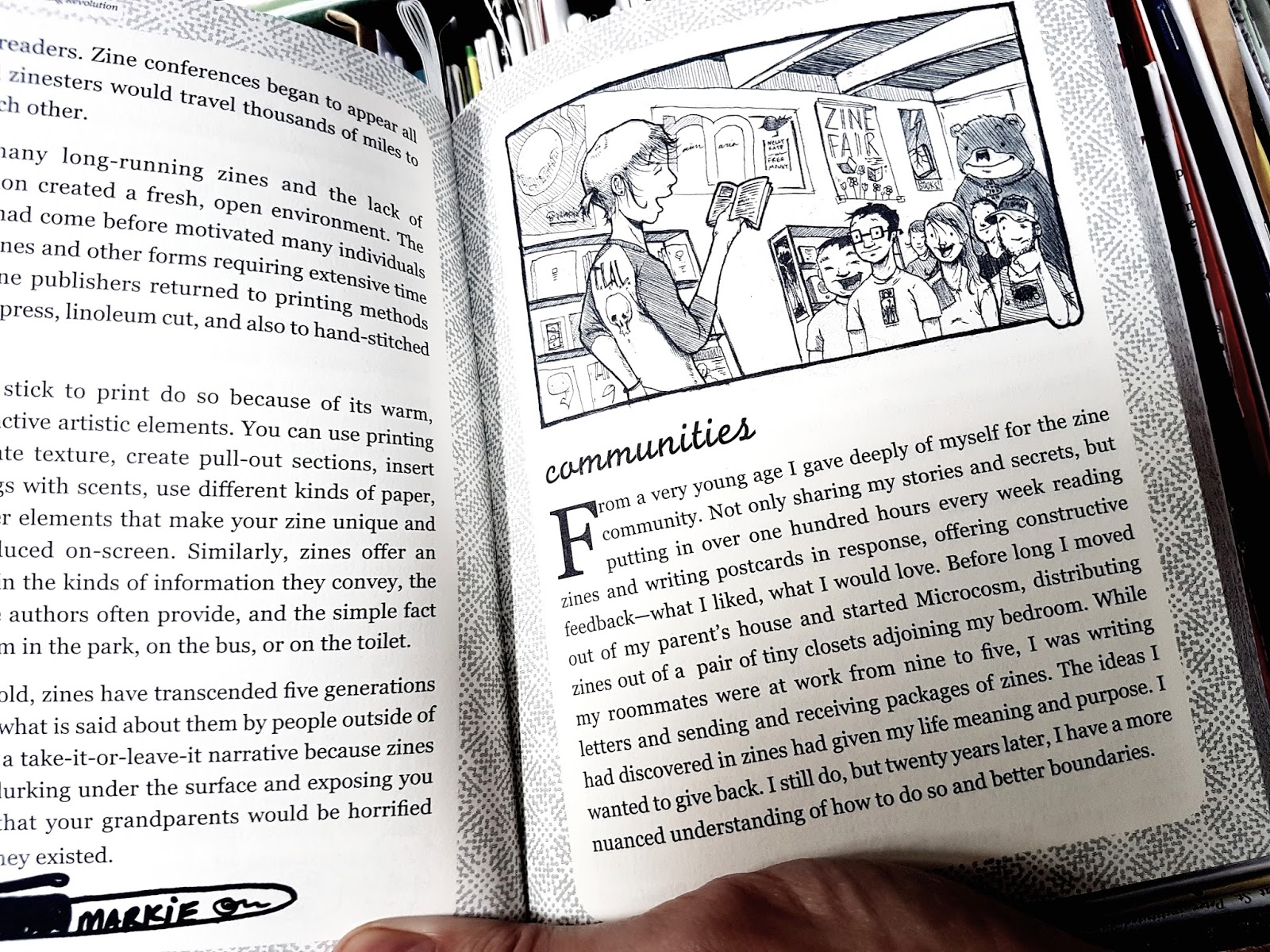
This is an updated and expanded 20th anniversary edition of the Microcosm's original Make a zine! The book guides you through chapters on 'behind the scenes' topics crucial to making zines - creative commons, communities, and contributors - as much as the more fun hands on side. 


There are contributions from other zine makers and shapers, including a great primer on DIY Comix by Fly. The history section reflects the changes in the zine community of the last 20 years, the rise of zine wikis and databases, review sites (*cough*) and forums. There is an interesting discussion of fake zines by Stephen Duncombe (author of the incredible Notes from Underground: Zines and the politics of alternative culture) - and how a shift towards a polished look, letterpress, or artist book style embellishment, is actually a good thing for contemporary zines.

Interleaved with the practical advice is a narrative based on the authors' experience of zines, running a distro, and a being a publisher. But even if you've also been around zines for 20 years, you should buy this book. It will invigorate your passion for reading and making zines. Make a zine! has made me want to read, review, and make more than I do already. And once you've read it, give it to a friend or a stranger who is just starting out, and who would perhaps benefit from basic, practical advice about binding, printing, the legalities of copying, and the giddy heights and lowest lows of collaboration. In doing so, you might just help someone start something special. 


Order Make a zine! here: microcosmpublishing.com/catalog/books/1202 or order a copy from your local bookshop. 

Microcosmpublishing.org 


Review by Nathan Penlington

Monday, June 9, 2008

Review of Dream Whip No. 14, 2006, Microcosm Publishing.

style="margin: 0px 10px; overflow: auto; font-family: sans-serif; width: 100%;">

via the black cloud by blackcloudphoto on 6/7/08

Several copies of this book were found in a plastic bin Steven left at our house that was to be donated to Columbus' new infoshop.

I got the feeling that the collection of Microcosm material was the excess stuff that didn't sell when he went on tour peddling anarchist material to young punks. I got the feeling this collection didn't sell because, well, it just wasn't that good.

Not sure why I choose to read Dream Whip first. Nothing obvious about it stood out. Maybe it was the size – a bound, soft-cover book comprised of quarter sheets of paper about an inch thick.

Bill Brown is the prototype diary-style zinester. While I generally shy away from these personal, heart-felt writings, this one stands out. I would, however, recommend reading it in small doses because the entries are so amazingly consistent I think I would have lost interest if I read too much in one sitting. These short reads are made easy thanks to the book's pocket size and short sections.

Filled with travel stories ranging from the American southwest to the heart of Europe, Brown is a man concerned with the simpler things in life and he enjoys digging just below the surface exposing his own unique observations about the world. His feel-good style of writing makes him seem like the kind of guy everyone would like, but might not get overly excited to see if he was passing through your town.

Shortly after finishing this book I watched Homeland Insecurity, Brown's documentary about the US/Mexican border which he narrates. Together, the book and film made me see Brown as a less quirky Ira Glass. If Brown had a larger budget, I could see his work being similar in style and quality to this American Life, the Showtime version, which is the best show on TV.

Some friends immediately dismissed Dream Whip because they didn't want to read some "rich punk's travel stories." While Brown has more privilege than most zinesters (he writes about taking a boat to Europe and renting cars while tales of roughing it - getting stranded or lost, dealing with inclement weather, or facing natural or man-made dangers - are rare), Brown is just so likeable. He's not elitist or ignorant; he simply loves the world around him.

While I enjoyed his writings about the subtle differences between Europeans, my favorite story is pure Americana. The tale takes place at the Raven's Grin Inn, a haunted house in Mt. Carroll, Illinois run year around. The two-hour tour, Brown writes, includes performances by an eccentric entrepreneur and attractions like a free-falling bed ride.

I'm reasonably sure the text is completely hand-written (it almost looks like it could be a computer-style imitating human shorthand), but Dream Whip is not difficult to read like others of its kind. Brown's handwriting is hauntingly perfect (he might have OCD), and the book is a quick read despite the daunting length of 336 pages.

Simple line-drawings of buildings and signs from Brown's travels break up the monotony of text well. The consistency throughout the book is comforting and compliments his writing style perfectly.

If your average zine is a C, Dream Whip hovers in the B+/A- range, but Brown would likely receive the higher grade because he's just so upbeat. While I enjoyed Dream Whip 14, I have no burning desire to read 1-13. I've had enough Bill Brown for a while. Think of him not as the guy you call to be your companion during an all-night rager, but the one you phone at 4 a.m. who salvages a bad night by telling you some good stories and making you hash browns.

Tuesday, August 28, 2018

Don't Be Retarded #1


Don't Be Retarded #1: Autistic Pride in a Neurophobic World 
Edited by Joe Biel / Microcosm Publishing

11cm x 18cm, 64 pages

$5 USD


"Autism advocacy has focused on the rights and struggles of parents over the past 30 years, resulting in an invisible population of disordered adults who have little voice and less support for what they are going though."

Don't Be Retarded is a new zine started by Joe Biel, the founder and manager of Microcosm Publishing, as a way to help counteract that trend and to foster "a social movement for the neurodiverse". It's an important aim. Those with invisible disabilities suffer the double ignominy of the burden of explanation followed by the resultant disability stigma. 

Joe explains the inspiration for the zine's title: 

"I began polling my Autistic mentees and peers. Just like me, everyone has suffered under the word 'retarded'. But taking the word away without taking away the stigma, bias, and attitude does nothing to take away the hurt and only insults our intelligence further". 


The contributors to Don't Be Retarded have largely been diagnosed as Autistic in adulthood, and although every individual has unique experiences, there are common themes of alienation, despair, and seeking acceptance, that run throughout the pieces.  

'Things I no longer have' by Eliot Daughtry is an insightful look at the sound equipment crucial to surviving 50 years prior to a diagnosis, and how the function of behaviours can be manifold; Partly Robot relates their experiences of working the perfect job for the detail orientated; Aaron Poliwoda's comic Autism-Man V's the evil Neurotypical discusses the difficulties surrounding a lack of Autism awareness; Tammy Porter contributes a moving reflection on a life lived undiagnosed; Ricki Bransen examines the lenses our lives are viewed through; Temple Grandin looks at how to reduce stigma by getting good at something; and Joe Biel's pieces offer a thought provoking look at attitude, perception, and discrimination.

Don't Be Retarded is an essential read both for anyone who has struggled, or is struggling, as a disordered adult, and for those open to understanding.

Buy a copy direct from Microcosm: microcosmpublishing.com/catalog/zines/9412


Review by Nathan Penlington


Thursday, August 23, 2018

Simple History Series #1


Simple History Series #1: Christopher Columbus & his expeditions to America
J. Gerlach

Microcosm Publishing

10.7cm x 14cm, 36 pages

$4


This is #1 of a series of short, pocket sized guides to the events and personalities that dominate history. First published in 2006, these have been reprinted with updated illustrations by Microcosm. While I am a huge fan of Microcosm's zine compilations I think the benefit of this series being in cheap individual editions is in allowing students of history a focused look at individual topics. 

J. Gerlach states in the introduction:

"We are taught that we, as humans, are always moving forward - that the mistakes and prejudices of the past have been overcome. The embarrassing details about our heroes are glossed over or completely omitted from the story. Because of these tendencies, the history we are taught doesn't make sense with the world we see around us."

As Columbus is taught as a kind of hero figure in the USA (only one of two individuals to have a national holiday named in his honour), it's fitting that the series begins by taking a look at the reality of his four voyages 'west to go east'. The text also gives an overview of his ambition, goals, and motivations, which add up to traits that merely reflect a desire for fame and fortune. 


The text is well written, concise and to the point, and also includes a bibliography of source material and further reading. While the illustrations help enliven the zine, the maps help clarify the voyages in a straightforward manner. 

If you're looking for a critical overview of a historical figure prone to being eulogised - for $4 it's a no-brainer. And if you want a zine to fit in your pocket that helps expand your world view, this series is a good place to start. As J. Gerlach says:

"We have to ask ourselves, what kind of heroes do we really want?"

Tuesday, May 24, 2016

Accountability Processes are Ableist as Fuck


Accountability Processes are Ableist as Fuck
28 pages, digest, heavy stock cover
$2

I had to look up ableist

There are intersecting dimensions to this publication. It is a prequel to a book Joe has out, "Good Trouble: Building a Successful Life and Business with Asperger's." In the intro, Joe talks about how Asperger's almost destroyed his life. But in that first paragraph the voice is confident and hopeful. Joe puts a personal face on a subject many of us struggle to understand and accept. Not just of Asperger's and autism, but of mental health in general. There is a universality to his story of being misunderstood, unexplainably out of step, and disconnected. He also gives voice to the common experience of relief one feels when finally correctly diagnosed. "I really am different, and it's not my fault."

He also chronicles the range of responses he gets from others; everything from, "oh, that makes total sense," to "that's just an excuse."

From this perspective, Joe's story is an elegant account of recovery and empowerment.

###

Regarding the overall quality of the zine, it is top notch. The writing is crisp and precise, the layout very clean, and the production is as good as a plain old zine can be.

###

The remaining aspect of this volume is about Joe's break up with his ex and the splintering of Microcosm books.

Joe's story of self discovery is intertwined with this other louder story. If you don't have the stomach for more of the Microcosm / Pioneer Press / Joe / Jennifer / Alex saga, this may not be for you.

On the other hand, if you've listened to one side of the story, you might as well listen to the other.

PO Box 14332
Portland OR 97293


review by Jack Cheiky
This zine is being donated to the Cleveland Zine Library after review.

Friday, November 30, 2007

Zine Review: Scam #5 1/2

Zine Review: Scam #5½

via Trading Stories with the Leaves by Trading Stories on 11/29/07

Arnold Zwicky wrote an interesting post for Language Log recently, about the blurred edges of technical and everyday words. He pointed out how "the common-language use of epicenter for the central point of an event" is slightly different from its original jargon meaning: "Technically, it's the location on the earth's surface over the place where the earthquake event happened, undergound."

When Erick Lyle named Scam #5½ "The Epicenter of Crime: The Hunt's Donuts Story", borrowing the phrase from a news broadcast, I suspect he was using epicenter in the common-language sense. But the technical meaning is perhaps even more fitting, because Hunt's Donuts — beneath the "OPEN 25 HOURS" neon sign — was the point where the underground centre was reflected on the surface. It was the place where the petty criminal underworld of San Francisco's Mission district met the world of the upstanding citizenry.

You can read part of the Hunt's Donuts story in a March 2000 article in the SF Weekly. By that time it was called Magic Donuts, and the city was trying to force the new owners to shut the place down, using their tactic of suing "Mom and Pop" store owners for social problems beyond their control. But if you want the full story, the real story of Hunt's Donuts on 20th and Mission, you need to read Scam #5½.

In Lyle's story, the Magic Donuts dispute is just the latest episode in a long history:

... the story of Hunt's is both less and more than news. Its a rumor, an illicit history, the pull of the gravity of the epicenter of crime. At 20th and Mission, battles to control the identity of the Mission have been acted out again and again, between ever changing sets of police and thieves over the years. In the story that follows we have the Irish cop who shut down the mission's Latino bars as his father shut down the city's gay bars. We have the young kid who couldn't beat the Hunt's sponsored team on the baseball diamond who grew up to try to shut down the shop as police captain. We have the Latino teenagers who hung out in front of Hunt's framed for a cop's murder in the famed trial of Los Siete de la Raza.

Hunt's Donuts was a microcosm of the Mission community, capturing both its successes and its failures, its hopes and its tragedies. Established by a pillar of the business community but condemned by the police, it was simultaneously a place where families would buy donuts after mass on Sunday and a place where drunks and junkies would trade goods of dubious provenance. In Scam #5½, Lyle brings the place alive on the page.

We see Hunt's through the eyes of its owners, its customers, the growing Latino population, the police — both sympathetic and otherwise, the drunks, the punks, and the yuppies moving in and gentrifying the Mission. Ultimately, Lyle is sad about Hunt's closing after 52 years as a Mission institution, and it is easy to see why: love it or loathe it, Hunt's Donuts was in the thick of things. Scam #5½ is a comprehensive social history and a pleasure to read.

Erick Lyle, Scam #5½, ¼ size, 32 pages.
Available from Paper Trail, Needles + Pens, McPheeters and Microcosm

Sunday, September 9, 2018

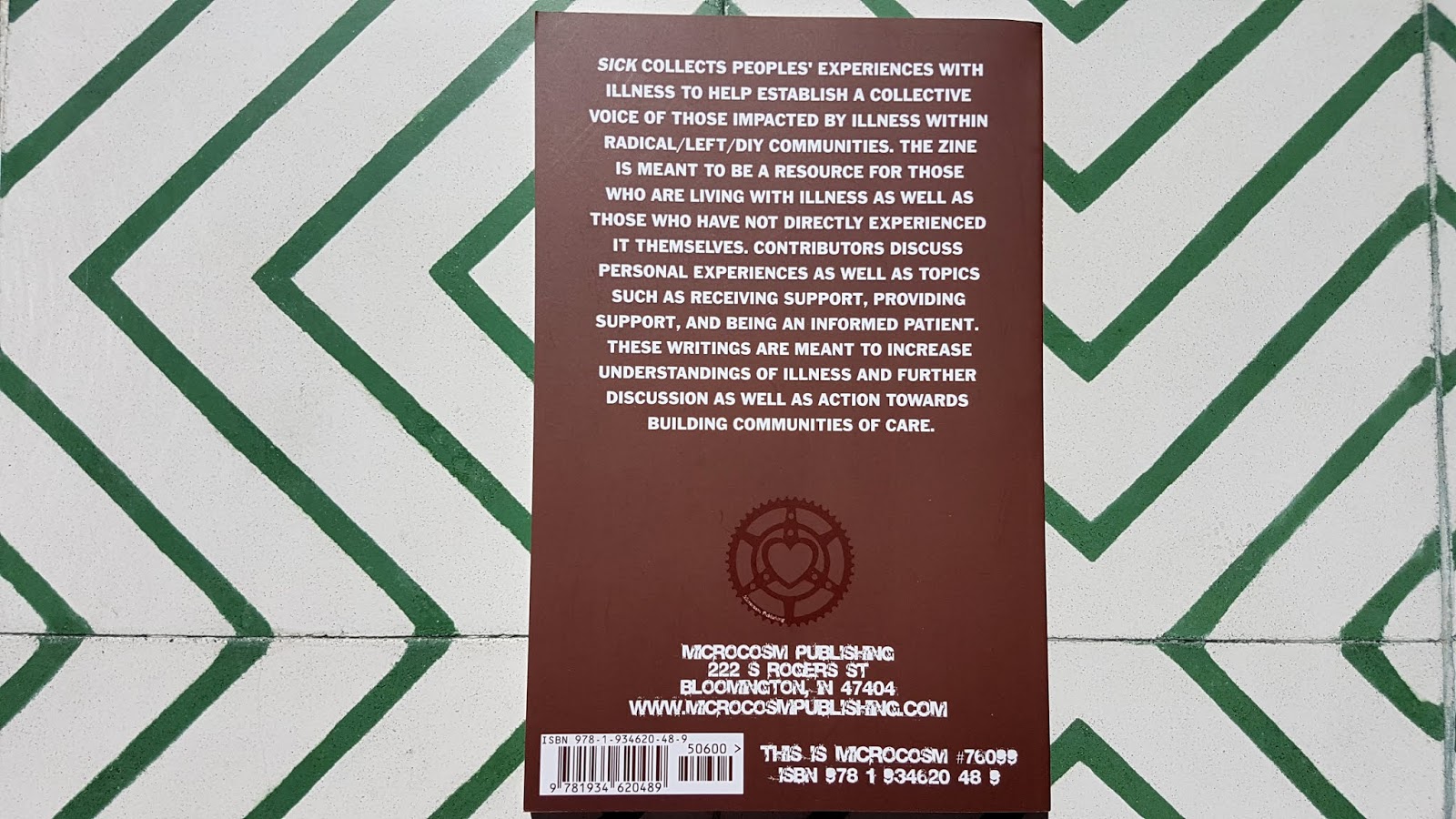
Sick: a compilation zine on physical illness


Sick: a compilation zine on physical illness 
Edited by Ben Holtzman

14cm x 21.6cm, 88 pages

Cost: offered as part of Microcosm Publishing sliding scale pricing $5-$7


I read every word of every zine that is sent to me for review. Occasionally the focus of a zine is so close to my own experience it can make that reading difficult. For me, Sick is one of those zines. 

I have a lifelong medical condition that results in permanent chronic joint pain. Its invisibility and long-termness brings with it additional social challenges that everyone with a chronic condition has to face: periods of isolation; having to explain or excuse yourself; 'behind the scenes' planning for the most mundane of activities; not knowing from one day to the next.


The pieces in Sick are written by those with physical illness, and by daughters, sisters, and friends. The conditions include cancer, multiple sclerosis, hypoglycemia, hepatitis, Lyme disease, and polycystic kidney disease. What comes across in Sick is not the details of individual conditions or individual suffering, but a collective need for understanding and awareness. Ben states in the introduction:
Too often those of us who are living with illness have felt that our experiences are not welcome in conversation, even within radical/alternative communities. Illness is seen as taboo...this zine collects peoples' experiences with illness to help establish and further a personal and collective voice of those impacted by illness. 

The writing throughout is excellent, and the zine is clearly lovingly produced and designed - with a stylish use of old medical textbook illustrations. I know I'm close to the subject matter, but at times Sick will be an emotional read for anyone. For example, part of Sarah Hughes' piece includes a verbatim letter written by her dad to his "precious dysfunctional family":

If you're talking to me and I sound happy, it means I'm happy. That's all. It doesn't mean that I'm not in a lot of pain, or extremely tired, or that I'm getting better, or any of those things. Please don't say "Oh, you're sounding better!". I am not sounding better. I am sounding happy. 

Sick is essential reading for those with physical illness, as well as family and friends of those with a condition. Topics also include receiving and providing support, as well as how to be an informed patient. And if nothing else, reading Sick will help open a dialogue in relationships where illness is a factor, to not proportion blame, to help erase the guilt of need. 

Search This Blog