zine, [zeen] noun. 1. abbr. of fanzine; 2. any amateurly-published periodical. Oxford Reference

..

Showing posts with label Punk. Show all posts

Thursday, October 11, 2018

Rum Lad - Issue #12


Rum Lad - Issue #12
by Steve Larder

A5, 28 pages, black and white on grey paper.

£3 (plus postage)


Rum Lad #12 is a funny & heartbreaking tribute to Steve's grandparents. His Gran died in 2013, followed by his Grandad in 2017. As Steve says in the introduction: 

"Grief can do all sorts of cruel things to your brain...the jarring lapse where you forget they're gone"

He goes on to point out that the hurt of grief is caused by love and affection. Steve has captured his love for his grandparents in this collection of short stories, and comic strip vignettes, that reflect the absurdity of everyday life and the unexpected moments that we store as tender memories: his Gran wearing a Tesco carrier bag as a substitute hood, and hanging sweary punk t-shirts on the washing line; his Grandad's relationship with Paxo, and a catalogue of his tattoos.


Rum Lad #12 is also an unflinching chronicle of his grandparents' decline - the failing bodies, and reversing of roles, that we all have to face as we age. 

Rum Lad has a trademark style of art - a combination of breathtakingly detailed line drawings that sit alongside more comic book style illustration. The writing in this issue reminds me most of Simon Moreton's Minor Leagues, not just the themes of memory and loss, they are both told with a similar warmth and humour. 


It's a no-brainer. Not only is it just £3, it's one of the best things you'll read this year.
Buy via Etsy: etsy.com/uk/listing/644672935/rum-lad-zine-12-comic-perzine

And visit Steve's site for more of his incredible illustrations: S
teveLarder.co.uk


Review by Nathan Penlington


Sunday, September 2, 2018

Random Notes 2


Random Notes 2: Pages of Blank Metal & Noise
by Matthew Rooney

36 pages, 11.5cm x 15cm. B&W print, cardboard cover. 


$4 (Canadian dollars)


Random Notes 2 is a follow up to the zine produced by Matthew Rooney in 2017 (read the review here). It's a hand bound collection of comics, illustrations, and collages, loving put together with a punk aesthetic. I say lovingly, because not only does gaffer tape look great as a spine, it also protects your fingers from those b@*t@rd staples. 


Taken together random notes form a satire on the state of American politics:

"No One Cares About Politics Unless There Is A Meme"

With side forays into sex, and the idiocy of human violence.

If you're into interesting little zines that fully embrace alternative diy culture Random Notes 2 is for you. You can see more images over on 
mjrzines.tumblr.com

To buy a copy email: mjjrooney {at} gmail {dot} com

Please say Syndicated Zine Reviews sent you.


Review by Nathan Penlington


Thursday, August 23, 2018

Break the Chain - Volume Three


A5, 36 pages
£3.23 (+ £4.03 p&p)

I’ve got a soft spot for Break the Chain. Nothing in its pages is relatable to my life – my knowledge of post-hardcore and post-punk music is shaky, I rarely share my political views and the closest I’ve ever gotten to Jacksonville, Florida is Canada. I am firmly outside of the target demographic.

I think the thing about this zine which resonates with me the most is its earnestness. Its cut-and-paste aesthetic is reminiscent of the early zines of the sixties and seventies, hastily photocopied, stapled and distributed while the pages were still warm. There’s a lot of heart in its pages.

The third issue offers more psychedelic artwork from Stacey Matchett, an intriguing artist who appears to have almost no online presence. Her drawings are as detailed and hypnotic as always, and they seem to be composed with a more definite sense of purpose than the pieces that have been included in previous issues.

There’s also work from an artist whose name I hadn’t heard before – Austin Redwood. His art is in total contrast to Matchett’s; serene paintings of trees and landscapes. This type of artwork in this type of zine is a surprise, but a welcome one.

In general, the band interviews are a fun read. Matt Sessions (creator of Break the Chain) has scored interviews with bands from across the Unite States, including Big Ups, Priests, UV-TV and Profit Prison. Each of the interviews are sufficiently engaging, but I can’t help but notice that most of the musicians’ answers to Sessions’ questions are astonishingly articulate, almost as if they’d had quite a lot of time to compose each response. It’s fair to say that the interviews are probably conducted long-distance, but I think this is an understandable trade-off for reaching bands outside of Jacksonville.

Sessions poses his trademark question to each of the bands: “What are you reading at the moment? Are there any books you’d recommend?” I’m still waiting for the day somebody reels off a reading list full of Andy McNab thrillers or Marian Keyes paperbacks, but the selection was as distinguished as always – titles by Joan Didion, Franz Kafka, Virginia Woolf and Arundhati Roy, amongst others. I guess artists appreciate art, no matter what the medium.

This volume is a solid instalment in the Break the Chain zine and it will be a pleasing read for fans of the first two volumes. It is interesting, impactful and illuminating – everything I’ve come to expect from this zine.


You can buy your copy of Volume Three of Break the Chain here.


Review by J.L. Corbett


Thursday, August 16, 2018

Shoes Fanzine #8


Shoes Fanzine #8: Interviews old & new
by Nate

June 2018

72 pages, 14cm x 21.5cm, b&w. 

$3 (Canadian dollars) plus p+p. Free to prisoners. 


The latest issue of Shoes contains varied and substantial interviews. While it's a zine pretty much grounded in punk, you definitely don't need to be part of that scene to discover something rewarding and thought provoking within its pages. The interviews tackle issues affecting countries the world over: the rise of white supremacy; the gentrification and cultural smothering of cities; the further marginalisation of certain communities.

Outside of those themes there are also very specific interviews that are utterly fascinating. For example Karmin recounts the story of when she sailed the Pacific Ocean for seven months with only her estranged dad for company. There is also an inspired then & now interview with the infamous Aaron Cometbus. Nate first interviewed him back in 1999, and asks the same questions again in 2018, without allowing Aaron to see his original answers. The result is a rare insight into the drives and despair of the man behind the longest running zine. 


In fact Cometbus is the closest comparison to Shoes that comes to mind - apart from the obvious overlap of punk & activism, there is a larger ethos both zines share. And from where we stand in 2018, spreading the reach of that ethos is no bad thing. 

To get hold of copy contact Nate directly: shoesfanzine [at] hotmail (dot) com

Or write: Shoes Fanzine, PO Box 88023, Chinatown, Vancouver, BC, V6A 4A4

Please say Syndicated Zine Reviews sent you. 


Review by 
Nathan Penlington

Saturday, April 28, 2018

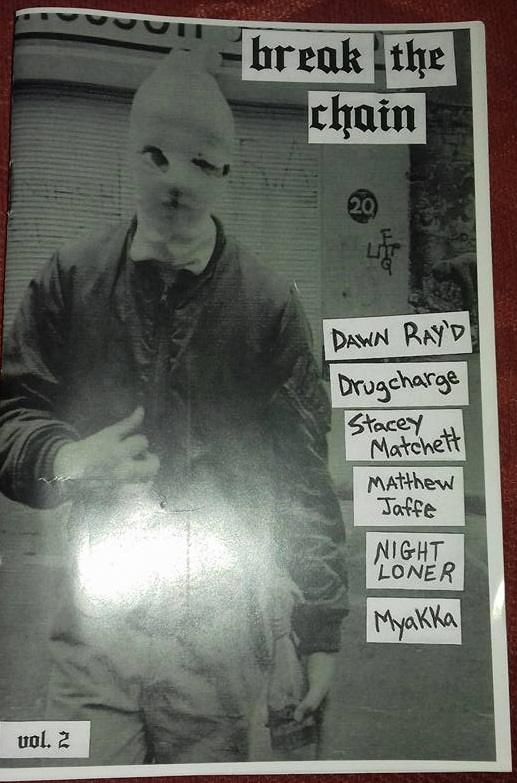
Break the Chain, Volume 2


 A5, 44 black and white pages
£2.90 (+£3.62 p&p)

The second volume of Break the Chain is a battle cry from the Jacksonville punk scene. Sequels are always tricky, and so I was eager to see if zine maker Matt Sessions could pull it off.

The first interview is with Dawn Ray’d, a black metal band from the north of England (my neck of the woods, how exciting!). Reading through this interview, I was a little disappointed with myself; my surprise at the band’s articulation and love of poetry (their band name comes from a poem by Voltairine de Cleyre) spoke volumes about my own preconceptions of heavy metal bands. Much of their interview was an exploration of the power and beauty of words, and yet it ended with a reminder of the anarchy at their core - “Fuck the pigs, smash the Nazis”.

This volume also offered fantastic artwork from Matt Jaffe. His images have been created with thousands of dots, each one carefully placed, each one a crucial part of a bigger picture. Jaffe’s artwork is sharply evocative, but more importantly it teases one’s curiosity – each image bears a strange caption (“alienergy”, “sickened”, “radiate”), none of which make sense straight away.

It’s clear that Sessions has held onto the same punk ethos that birthed the fist volume of Break the Chain, and he’s built on this significantly in the second volume. The pages are crammed full of content, each item fitting well within the theme of angry protest whilst offering their own distinct point of view.

Sadly, some items fall a little short. Ed Dantès’ essay “In Prisons We Trust (part one)” is full of angry commentary, but unfortunately offers very little depth or intelligent examination of the points he is criticising. I was really rooting for Dantès – his argument started off well, gained momentum, but the deathblow never came (perhaps it arrives in part two).

This volume is a gripping read, and I think this has a lot to do with Sessions’ obvious love for the music scene in his area. It’s clear that he doesn’t make Break the Chain for profit or notoriety (you won’t find his name anywhere in these pages), but because he loves the Jacksonville scene.

On the whole, the second volume of Break the Chain is a triumph. It it builds on the themes of protest and angst introduced by its predecessor and the result is a zine which is polished and cohesive – clearly, Sessions is finding his groove.

Volume two of Break the Chain can be bought here 


Review by J.L. Corbett

Sunday, March 4, 2018

Break the Chain: Volume 1


 A5, 28 (mostly) black and white pages
£3.76/$5.19 (+p&p)


The first volume of Break the Chain (created by Matt Sessions) is an anarchist’s guidebook to the punk rock underbelly of Jacksonville, Florida. My perception of Florida has come almost exclusively from the images on my television screen; endless sunshine, orange juice aplenty, home of Disney World – everything that my dreary British life is not.

It was quite the surprise to find that this Floridian zine is gritty, anarchistic and in grey scale. The overall appearance of Break the Chain is dark and distinctive. Particularly strong is the artwork from Stacey Matchett, a sort of grunge expressionism wherein the figures in all her drawings share the same tired gaze. Their eyes haunt and resonate.

The first interview is with Woven In, a surf-rock regular on the Jacksonville music scene whose responses to standard interview questions are refreshingly intellectual and offer a surprisingly deep contrast to her “beach-goth, post-punk dream-come-true” music. Not long after reading her interview, I was listening to her music on Youtube.

Also interviewed are black metal grindcore band, Wørsen. Whilst they do seem somewhat excited about the release of their newest album, the theme of their interview appears to be apathy. They say “[the gigs] tend to run together after a while”, and when speaking about their songs they make comments such as “It’s also one of the newest songs we’ve written, so I’m not burnt out on it just yet”. It’s a shame – had they been a little more enthusiastic about their own music, it would have been a lot easier for the reader to get on board with them. I found myself more interested in finding out about Sickmark, the German power-violence band briefly mentioned at the beginning of the interview.


All sense of apathy is quickly forgotten with the zine’s final interview: an in-depth conversation with Penelope Spheeris (director of landmark punk films such as The Decline of Western Civilisation and Wayne’s World). How on earth did the creator of Break the Chain pull that one off? It doesn’t matter, of course (but I need to know!).  Spheeris speaks with great articulation about the punk rock aesthetic, the importance of dedication and devotion to one’s work and the controversial impact of The Decline of Western Civilisation, which was banned after just one screening in Los Angeles. It’s a strong end note and an impressive coup for the first volume of Break the Chain.

Break the Chain is definitely worth a read. As someone across the Atlantic I enjoyed the zine as a brilliant showcase of the talent in Jacksonville’s alternative community, and I expect Jacksonville natives will enjoy it as a token of pride for their hometown.

Volume one of Break the Chain can be bought here .


Review by J.L. Corbett

Wednesday, September 27, 2017

Headwinds - Issue #1

A4, 24 pages (23 black and white pages, colour front cover).
 £1.50 (+£1 p&p)

“Headwinds… refers to things blowing in the opposite direction to the one you’re moving in,” explains Mike G in the introduction to his fanzine of the same name. This theme of pushing through mainstream culture persists throughout the first issue, which contains comics, band interviews and reviews.

The layout of Headwinds is immaculate; it looks less like a zine and more like something you’d find in your local newsagents nestled between NME and Mojo. The time invested in its quality makes it a pleasant read – there’s no text disappearing into the centre crease or dodgy photocopying going on here.

Whilst aesthetic appeal is important, it means nothing without compelling content. Luckily, Headwinds is as interesting as it is pretty. Given that the zine only costs £1.50 (£2.50 online), I was surprised by just how much content there was – a couple of lengthy interviews, comics, articles, and tons of underground gig reviews – and how decidedly different the items were from those typically seen in mass-produced magazines.   

I particularly enjoyed the interview with Emma, lead singer of The Natterers, which covered topics such as world environmental issues, the perks and dangers of living in a digital age and the declining bat population in the UK. It was weird, and I liked it.

Stranger still was Mike G’s retrospective account of the Treeworgery Tree Festival, which he attended in the summer of 1989. Waiting 28 years after the fact to write about an obscure festival in Cornwall doesn’t make sense. It just doesn’t. But it was so well-written that I found myself filled with nostalgia for a place I’d never been, and for a time in which I hadn’t existed. I found myself feeling increasingly wistful for hitch-hiking, serendipitous friendships and weekend tickets for £20.

Headwinds feels like a relic from the past, but it doesn't come across as dated. Perhaps it’s Mike G’s unabashed enthusiasm for the stuff he’s writing about that gives the zine a fresh, current feel, or maybe it’s down to its overall polished appearance. Who knows? The one thing that’s clear is that it’s very tricky to write about underground culture in an accessible way, and Headwinds is an excellent example of how to do it correctly.

To keep up with Headwinds’ latest updates, you can follow @tblastzine on Twitter. You can get a copy of your own through PayPal by emailing tblastzine@gmail.com.


Review by JL Corbett. 

Thursday, September 10, 2015

http://www.inpursuitofexpression.com/2015/09/i-read-zines-10.html

http://www.inpursuitofexpression.com/2015/09/i-read-zines-10.html

Friday, 4 September 2015


I READ ZINES [#10]


Negative Assets is a literary zine with a punk ethos produced by students at California State University. Any time I come across a lit zine with a punk aesthetic I am drawn to it like a fly to shit. When I discovered this zine during some boredom induced Googling I immediately emailed the editor and got him to send me a copy. It arrived a week later and I dove straight in. I was not disappointed. It is full of excellent writing; entertaining stories, a smattering of poetry and some punk and metal album reviews as well. The stand out pieces for me were a story by editor Taylor Farner called 'Big Red Roger' about a killer Octopus and two stories by Harmony Hertzog, both of which are tales are urban exploration with ghostly twists. I await the second issue with bated breath.
UP THE LIT ZINES!


Shelf Life zine documents the adventures of its creators Tim & Annie in their quest for used books. These two intrepid lit fiends will travel high and low in search of books and their dedication to the printed word is nothing short of inspiring. This particular issue largely focuses on their experiences with library sales. Now these library sales are not something that happen in the UK (not to the best of my knowledge, and if they do, they are certainly not to same scale as in the US) so they were very interesting to read about. Their experience of 'scanners' (people who scan bar codes to assess a book's resale value) was a particularly frustrating phenomenon to learn about. My only gripe with this zine was Tim & Annie's predilection for non-fiction books. Being an avid fiction reader myself I found myself begging them to tell me about their fiction loves. Next issue, maybe?! 


I don't know whether this is fiction or memoir or an intricate weaving of both. The writing feels too raw, too tangible to be entirely fiction, but the best writing always does, doesn't it? This zine is truly beautiful; a handmade masterpiece. A common trope of zines is that they are robust, thrown together and rough around the edges. A High Degree of Spring Fever is entirely the opposite, and refreshingly so. It is delicate and precious. A myriad of different paper stocks and textures. You don't read this zine so much as experience it. It is a collection of vignettes of spring, of heartbreak and regret, of what ifs and whys, of hope and the future. It is layered and precise and wonderful and I loved it. I wanted to breath it in and hold on to it forever. I also want to give it away. To give it to everybody I know and implore them to read it. That is the worst part about great zines; you want to share them with everyone but also want to keep them for yourself. There are only fifty copies of this in existence, don't waste any more of your life, buy one now.


Reviews by Martin Appleby


Monday, July 22, 2013

Bring on the Dancing Horses


By Shaun
PO Box 1282
Fullerton, CA
92836, USA

Bring on the Dancing Horses is another zine by the author of There is a Danger, which I reviewed last month. It covers much of the same material as that zine (bicycle trips, exploring, abandoned buildings), but is much longer, and perhaps because of this is able to have more of a narrative in places.

Specifically there's a lot written about a giant squat Shaun stayed in while in New York City, the people he met while he lived there, the adventures they had, and how they were eventually evicted. As a person who enjoys abandoned buildings, urban exploration, dumpster diving, and adventures, this stuff really appealed to me, and Shaun's accounts of hiding in dark rooms filled with junk while the police walked by, or sleeping in a cleaned out elevator control room successfully managed to paint pictures in my mind.

I read Shaun's zine at a very specific time when it may have had more of an impact on me than even a week ago. I have a full-time job I find to be (while somewhat worthwhile) incredibly boring. My plan was to work until August, visit some friends and family, and then start a new chapter of my life in another city in September. I have recently discovered that this new chapter will not be what I had planned, but will instead be something currently entirely mysterious to me. While some find this liberating, I've spent the last seven years of my life feeling fairly rudderless, and had hoped to have a goal slightly longer than "pay this month's rent". While I can work my boring job if I have something to look forward to, I now wonder why I should even bother with my job, and whether I should, like Shaun, give up on the capitalist society we exist in, and become more outside it than I already am, rejecting societal norms, and existing as a scavenger. This was only cemented by the sudden onset of spring, and days with 20 degree weather (to all the Americans that read this remember that I live in Canada, so this is actually warm).

PostScript: Included with Shaun's zines I received a letter that described what his zines were about. One small piece really stood out to me. It was about how part of this zine was about "a girl (always a girl...)", and really, that's kind of true. For a certain type of person, there is always a girl. One that you find, one that you leave behind, one that you remember.

Excerpt (I don't usually do these, but thought I should for this zine):

I woke up early and set off into the building, flashlight in hand and a feeling of vertigo from the sheer size of the labyrinthian halls, the multiple wings and adjoined church left eerily empty and bathed in dust and stained-glass light, and so much detritus from its past lives as a community center. On the third floor was the main room, lined by open windows whose glass had been removed, now letting light, noise and breeze flow lushly throughout the room. Most other windows in the building were boarded up, allowing in only a small sliver of light through the triangular wedges cut from the bottom of each plywood sheet. This made nearly every room dark, menacingly silent, and possessed of so many odd and curious details of which one could mine a litany of scenarios and theoretical explanations for.

On the lower floors were the large performance theater and basketball court. Chairs were scattered about the floor, a painted set remained standing on the stage, and a tall laddered-platform on wheels sat in the middle of the room. It was hard to know if these all were left in carless [sic] abandonment or if they were the remains of some squatter-party, as Bowery Manor at once appeared both the elegiac remnants of a once-bustling community space forced out by the city of New York and a boundless playground for those who stumbled upon the shell, determined to breathe life back into it. Unfortunately, the building being closed off meant that it was illegal to be anywhere on the property, and anyone coming or going or inside Bowery Manor had to be ware of any police of HPD presence around the building. Thus, besides the metal door installed by the kids and secured with chains and padlocks, the first floor also had a large metal beam wedged between the stairs and the rollgate, the only accessible entrance to anyone who did not want to squeeze through the sledgehammered hole beneath the tarp or climb through a second story window.

Debris lined the floor nearly everywhere you looked - phone books, paper, clothes, boxes full of completely useless objects, nearly any imaginable functionless item could probably be found somewhere on the floors or shelves or in the drawers or in any of the other nooks and crevices in the building. In some rooms, you were not stepping on any floor at all but on the slippery and unstable mountains of old magazines, computer equipment, kitchen tools, CD cases. The swimming pool in the basement was filled to an even six inches below the brim, not with water but with junk.

(Originally written for 365 Zines a Year.)

Tuesday, July 16, 2013

Gadgie 24


By Marv
PO Box 93
Boston
Lincolnshire
PE21 7YB
England

Gadgie is another of those big, thick (over 30 pages) punk zines that covers music, zines, complaints, and whatever else is running through the creator's mind.

Gadgie's been coming out for ages, and its creator Marv is now in his late 30s, married, and even has a child. Old punks don't die, they just (pro)create the next generation.

In this issue Marv talks about the punk scene in Boston, England (both current and its origins), going to Loch Ness for a holiday with his partner and kid, misheard lyrics, a pretty epic account of every injury he's ever acquired while playing soccer/football, and loads of other stuff.

I like how Marv seems really enthusiastic about everything, and how being injured bothers him because it means he can't go and dance at punk shows. However, his nonstop style of writing was kind of exhausting, as you don't really have any idea when the longer pieces are going to end or what's going to happen next.

Marv has a really distinct style of writing, a sort of stream of consciousness "I did this, then I did this, then this happened" type of thing. If it appeals to you you'll probably be happy to read anything he writes, but if it doesn't then I'm not sure there's any topic he could get you to read about. I think I fall somewhere in the middle.

(Originally written for 365 Zines a Year.)

Sunday, March 24, 2013

Something for Nothing #65


Something for Nothing #65
digest, 36 pages, free (send stamps)
This is the Tape Issue of Something for Nothing. Idy has dug out his cassette tape collection and written reviews of all the cassette only releases that he has. There are a bunch of them, so the bulk of this issue is taken up by that. But he also squeezes in some beverage reviews, “Kinko’s I’ve Been To” (for the old school zine folks), and a piece about how he spent a recent birthday. Whether it’s this issue or another one, it's always worth your time to get your hands on a copy of SfN.
Something for Nothing
516 Third Street NE
Massillon, OH 44646
USA

Something for Nothing #64


Something for Nothing #64
digest, 40 pages, free (send stamps)
Just as you’ve come to expect from Something for Nothing, this issue is packed with interesting and informative reading. Idy reviews the records of three very lesser known punk bands: Group of Individuals, AOS3, and Schwartzeneggar. He also reviews 11 Christian themed books, offering his thoughts and views (from a faithful perspective) along the way. His familiar “______ I’ve Been To” section is about record stores this time around, plus Beverage Reviews are back this issue. Always text heavy and always worth picking up.
Something for Nothing
516 Third Street NE
Massillon, OH 44646
USA

Thursday, May 10, 2012

Pogographie 4

Pogographie 4 (Germany)

Hier mal die Pogographie 4. In der es doch etliche Veränderungen zur Pogographie 2 gab. Vieles wurde rausgeschmissen und eine Menge Sachen neu aufgenommen. Das ganze noch etwas erweitert mit Punk aus dem deutschsprachigen Raum. (Östereich und Schweiz) Heute kommt einem die Pogographie ja schon etwas nostalgisch vor. Durch die Möglichkeiten des www. Ich erinnere an Francks Punk-Disco.Com. Obwohl die nur bis 84 die Daten bereithält. Ich schaue trotzdem immer wieder mal gerne in die Pogographie. Was ich mich frage ob es tatsächlich eine Pogographie 3 gab. Bis jetzt ist sie mir noch nie untergekommen. PDF Download
original blog post

Sunday, April 22, 2012

Busking issue 1


By Celeste
www.etsy.com/shop/ofcourseyoucan
notfitforsociety.tumblr.com

I think busking is pretty neat, and to some extent I envy people who have the skills and personality to successfully perform in front of other people (and make a living from it! I don't think I'd make much money busking by offering to edit things)

Celeste has been playing accordion for several years, and makes her living from it. Of course "her living" is far different from what most people would consider: she eats from dumpsters, doesn't own any new clothing, and doesn't really buy anything. Of course she's perfectly happy doing this, as not having a regular 9-5 job means that she can spend her days doing what she loves: playing accordion, volunteering, making art, and other fun things. She actually pities people who have deadening office jobs, and as someone who has one of those jobs I kind of envy her life.

This zine is filled with stories and anecdotes from Celeste's times busking across Canada. Some are told in comics, while others use text. She also has an FAQ of questions people ask her while she's busking like "Are you on drugs?" and "Are you actually rich?". The whole zine is told in an upbeat and appealing way that makes me wish that I was friends with Celeste and got to hang out with her.

I recommend this zine, and am excited to learn that she's almost finished her second issue. Check out her tumblr for some of the comics that will be in issue 2!

(Originally written for 365 Zines a Year.)

Wednesday, April 18, 2012

Bring on the Dancing Horses


By Shaun
PO Box 1282
Fullerton, CA
92836, USA

Bring on the Dancing Horses is another zine by the author of There is a Danger, which I reviewed last month. It covers much of the same material as that zine (bicycle trips, exploring, abandoned buildings), but is much longer, and perhaps because of this is able to have more of a narrative in places.

Specifically there's a lot written about a giant squat Shaun stayed in while in New York City, the people he met while he lived there, the adventures they had, and how they were eventually evicted. As a person who enjoys abandoned buildings, urban exploration, dumpster diving, and adventures, this stuff really appealed to me, and Shaun's accounts of hiding in dark rooms filled with junk while the police walked by, or sleeping in a cleaned out elevator control room successfully managed to paint pictures in my mind.

I read Shaun's zine at a very specific time when it may have had more of an impact on me than even a week ago. I have a full-time job I find to be (while somewhat worthwhile) incredibly boring. My plan was to work until August, visit some friends and family, and then start a new chapter of my life in another city in September. I have recently discovered that this new chapter will not be what I had planned, but will instead be something currently entirely mysterious to me. While some find this liberating, I've spent the last seven years of my life feeling fairly rudderless, and had hoped to have a goal slightly longer than "pay this month's rent". While I can work my boring job if I have something to look forward to, I now wonder why I should even bother with my job, and whether I should, like Shaun, give up on the capitalist society we exist in, and become more outside it than I already am, rejecting societal norms, and existing as a scavenger. This was only cemented by the sudden onset of spring, and days with 20 degree weather (to all the Americans that read this remember that I live in Canada, so this is actually warm).

PostScript: Included with Shaun's zines I received a letter that described what his zines were about. One small piece really stood out to me. It was about how part of this zine was about "a girl (always a girl...)", and really, that's kind of true. For a certain type of person, there is always a girl. One that you find, one that you leave behind, one that you remember.

Excerpt (I don't usually do these, but thought I should for this zine):

I woke up early and set off into the building, flashlight in hand and a feeling of vertigo from the sheer size of the labyrinthian halls, the multiple wings and adjoined church left eerily empty and bathed in dust and stained-glass light, and so much detritus from its past lives as a community center. On the third floor was the main room, lined by open windows whose glass had been removed, now letting light, noise and breeze flow lushly throughout the room. Most other windows in the building were boarded up, allowing in only a small sliver of light through the triangular wedges cut from the bottom of each plywood sheet. This made nearly every room dark, menacingly silent, and possessed of so many odd and curious details of which one could mine a litany of scenarios and theoretical explanations for.

On the lower floors were the large performance theater and basketball court. Chairs were scattered about the floor, a painted set remained standing on the stage, and a tall laddered-platform on wheels sat in the middle of the room. It was hard to know if these all were left in carless [sic] abandonment or if they were the remains of some squatter-party, as Bowery Manor at once appeared both the elegiac remnants of a once-bustling community space forced out by the city of New York and a boundless playground for those who stumbled upon the shell, determined to breathe life back into it. Unfortunately, the building being closed off meant that it was illegal to be anywhere on the property, and anyone coming or going or inside Bowery Manor had to be ware of any police of HPD presence around the building. Thus, besides the metal door installed by the kids and secured with chains and padlocks, the first floor also had a large metal beam wedged between the stairs and the rollgate, the only accessible entrance to anyone who did not want to squeeze through the sledgehammered hole beneath the tarp or climb through a second story window.

Debris lined the floor nearly everywhere you looked - phone books, paper, clothes, boxes full of completely useless objects, nearly any imaginable functionless item could probably be found somewhere on the floors or shelves or in the drawers or in any of the other nooks and crevices in the building. In some rooms, you were not stepping on any floor at all but on the slippery and unstable mountains of old magazines, computer equipment, kitchen tools, CD cases. The swimming pool in the basement was filled to an even six inches below the brim, not with water but with junk.


(Originally written for 365 Zines a Year.)

Saturday, April 14, 2012

Gadgie 24


By Marv
PO Box 93
Boston
Lincolnshire
PE21 7YB
England

Gadgie is another of those big, thick (over 30 pages) punk zines that covers music, zines, complaints, and whatever else is running through the creator's mind.

Gadgie's been coming out for ages, and its creator Marv is now in his late 30s, married, and even has a child. Old punks don't die, they just (pro)create the next generation.

In this issue Marv talks about the punk scene in Boston, England (both current and its origins), going to Loch Ness for a holiday with his partner and kid, misheard lyrics, a pretty epic account of every injury he's ever acquired while playing soccer/football, and loads of other stuff.

I like how Marv seems really enthusiastic about everything, and how being injured bothers him because it means he can't go and dance at punk shows. However, his nonstop style of writing was kind of exhausting, as you don't really have any idea when the longer pieces are going to end or what's going to happen next.

Marv has a really distinct style of writing, a sort of stream of consciousness "I did this, then I did this, then this happened" type of thing. If it appeals to you you'll probably be happy to read anything he writes, but if it doesn't then I'm not sure there's any topic he could get you to read about. I think I fall somewhere in the middle.

(Originally written for 365 Zines a Year.)

Saturday, January 14, 2012

Lucid Frenzy Digest 2011


By Gavin Burrows
lucidfrenzy.blogspot.com

It's almost...ironic that I reviewed a zine about about mental health issues and then almost immediately didn't update for two days because of my own problems. Haha. Hilarious! (No wait, it's not.)

Um, so, this is a collection of pieces that Burrows has run on his blog, and despite liking what I read in the last issue of this zine, I've never actually gone to his blog to read anything. This is probably because Burrows' pieces are quite long and in-depth and take a while to digest and process. Thus I find it easier/better to read these things in paper form when I'm not being distracted by someone talking to me in another window or funny pictures of cats or something.

In this issue Burrows talks about zines, and reviews concerts, movies, and art shows. I enjoy Burrows' general writing style, which is most evidenced by the fact that I read all of his pieces about music I had almost no familiarity with. Music articles/interviews are probably the bits of zines I skip over with the most frequency, as I find that they generally require you to have knowledge of the artist to really get anything out of them. Here, however, Burrows has managed to weave information about the band/music, history of the genres, and descriptions of the bands that are considerably more informative than "band x meets artist y". So yeah, I enjoyed reading them even if I don't want to seek out what the bands actually sound like. That's what music writing should be like!

Though I must admit that the repeated references to Francis Bacon kind of flew over my head. I guess I should read more about him at some point.

(Originally written for 365 Zines a Year.)

Tuesday, May 3, 2011

Distort #32

Distort #32


16 pages, A4, $2.50, available from Sticky
First copy of this punk zine I've seen, although read good things about it elsewhere, so big thanks to Sticky for sending me this one.
This is part one of a look back at the 'best of' Distort - this issue covers Distort #7-13. "Wait a minute", I thought. "#7?" The unnamed (?) editor explains this in his introduction. It started as a "stupid myth" that issues #1-6 were all immediately out of print or short run or mix tapes, but the reality was that he'd been writing hardcore zines since he was 15 (Stop And Think, No Longer Blind, Room 101, and On Fire) but none of them made it to #7, so he figured he would end this curse by starting his new zine at that number.
A highlight - the story about his grandmother (a Latvian refugee), now suffering from dementia ("...she attempts to eat her food with a napkin as a knife. She makes sandwiches using the plate as a top layer, and she loses her way to the bathroom."). He writes (intro to Distort #10) that last week he found out that she was a Nazi sympathizer. The only way he could understand this was through the Nazi's appeal to the herd mentality, and national/racial pride. He relates this to his passion for hardcore/punk - "these offer an anti-herd mentality, a hostility to the crowd."
Reading some of the band interviews here, the overriding motivation seems to be violence, aggression, nihilism. From interview with Left For Dead band member describing a H-100's set - "They started, the singer threw something really heavy straight ahead of him, not even looking. Someone took out the bouncer, two girls were punching each other's heads in and there were at least three all out fistfights by the first chorus, no joke."
Another highlight is in the interview with Formaldehyde Junkies, where band member Andy answers a question about their song 'Now Don't Go Start Your Own Band", written because of the overload of shitty hardcore bands. It made me laugh because the zine world too has this problem. It's funny to me, with the often-heard exhortations by some ziners, '"Hey! You too can start your own zine!", to rather say, "Hey! No need to try this yourself! By all means please don't feel compelled to make your own zine!"
[Formaldehyde Junkies (great name!) also have their own wonderfully-named record label, Fashionable Idiots Records]
The editor also has a couple of quirks - one of which is his love of/focus on hardcore/punk bands from Cleveland (the only thing I know about Cleveland is that it's the city Harvey Pekar came from); the other of which is, he often begins an interview with a question about the band's school, work and church (or worship) life.
Distort was a good read. I'll be tracking down the next issue for sure.

Tuesday, April 5, 2011

Loserdom #21


loserdomzine@gmail.com
www.loserdomzine.com

One of my favourite things about reviewing things for this blog is that I read so many random things, and sometimes I am completely and utterly blown away by content I did not expect.

That is the case with Loserdom #21. I'd read some issues before, but nothing prepared me for the massive (over twenty pages!) history of the Dalkey punks that appeared in this issue.

Dalkey is a village suburb of Dublin in Ireland, and it doesn't seem like that exciting a place to live. Anto grew up there, and remembers being a little kid in the early '80s and being both scared and fascinated by the punks he saw hanging around town. Almost thirty years later he's tracked five of them down and interviewed them about what being a punk in that time was like, how they got involved with the scene, what music they listened to, how they dressed, where they hung out, how the group came to an end, and what they're up to now.

It is an incredibly epic piece of journalism, and feels more like the basis of someone's thesis in folklore, anthropology, sociology, or history than an article in a zine. It's a fascinating piece made all the more interesting because of the real emotions that the interviews conjure up in people. You can feel the joy and fun that these people had back when they were kids, and then, in the most brutal and unexpected part, there is a tragedy. I don't really want to spoil what happened, but it was a big enough thing that it was mentioned in newspapers at the time (which have been dug up, photocopied, and included here).

Even if that was the only thing in Loserdom #21 it would be worth picking up, but this is a massive zine and there's loads of other stuff too! Comics about riding bicycles, an interview with a woman who's been busking in Dublin since 1985, and more. Not all of it appealed to me, but that's always the case with anthologies, and I think this is definitely worth checking out.

(This review was originally published on 365 Zines a Year.)

Saturday, March 12, 2011

Loserdom #20


loserdomzine@gmail.com
www.loserdomzine.com

As with most punk zines this issue of Loserdom is filled with reviews of 7 inch records and other zines, interviews with bands, and scene reports.

However! It is important to note that even if you have no interest in those things at all, this zine is still worth checking out for a number of articles and interviews on some pretty neat and interesting things.

The first of these is an illustrated piece about a food co-op and a discussion that they had concerning vegetables from Israel. To boycott or not to boycott was the question that concerned them, and while both sides of the argument are represented here the author makes no secret of what side of the argument they fall on. The author talks to a number of other food co-op members and asks them about the idea of a boycott and why they thought it, at least initially, failed. It's interesting to look at things like this and I wonder if people are becoming less political than they have been in the past. You read about things like boycotts of South Africa in the 1980s and political songs getting airplay and I find it puzzling; have people just became apathetic or has our society changed in some other way? Hmmm...I feel like I need to discuss this with someone in person.

The second piece is an interview with one of the people that works at La Fanzinotheque, which seems to be a pretty rad library/art gallery/social centre type place in Poitiers, France. It's pretty inspiring that a place like this has been around for over twenty years! My only problem with this (and a couple of the other interviews in here) was that it seemed to reprint everything that the other person said/wrote, and I think parts of it could have been edited a bit.

There are also pieces on digital storytelling, winter cycling/swimming (horrifying!), a comic about how punks really can't seem to stop drinking, and an interview with a guy from Poland who runs a distro/label in Ireland that is pretty interesting, even if you're not into the scene, as it discusses some of the economics behind that sort of thing (ie. don't start a punk label if you want to get rich).

(This review was originally published on 365 Zines a Year.)
Search This Blog